Paul:

There is a new guy on the Flyrotary list named Leon Promet, he
seems to be in the same category as Lynn Hanover, has lots of
practical experience racing.  I was rather impressed with some
of the information he gave George about the Mazda transmissions,
so I thought I would get his take on what I am doing.

Now George and I are similar and that we are both borrowing a
lot of technology from the car, in different ways.  My philosophy has
always been that if it's been working and proved itself in the car
for years, that to deviate from that is actually taking on more risk.
That is unless you do lots of engineering analysis and testing to
verify your changes.  I have been fairly successful to date with this
approach, with 120 hours on my plane now.

But I wanted to get Leon's take on direct drive, below is the exchange
that took place.  Leon has made some statements that now make me
nervous!  I would like to get your opinion on some of his comments,
especially about the front thrust plate, bolts, and front side housing
taking
the thrust loads.  You and Tracy are more qualified to judge his
statements
than I am.  I have an engineering background, but not in mechanical
engineering.  I probably have just enough knowledge to make myself
dangerous.

Perry Mick wrote:

Leon:

I see you are new to the flyrotary list, and have a lot of knowledgable
information to impart to George about his transmission psru.

Well, I took a different tack, direct drive.  Since I'm the only one
doing it so far, no need to bother the whole list, but why don't you
take a look at my site (link below) and give me your take on it.

I was worried about the thrust bearings, so on my first annual last
August, I took the front cover off and inspected them.  They were
fine after 100 hours of flight.  But I replaced them anyway since
they were cheap.  Back flying again since Sept. 7, now have 120
hours.

Leon responded:

Hi Perry,

Yair, I've already been to your site a while ago.  Nice idea. Nice
plane.
 Nice site You have obviously put in a lot of thought!

Might even work better with a turbo engine!  Trouble is,  I can't see a
ducted fan working in my app.  As a first plane,  I want a simple
conventional 2 place, side by side aerobatic aircraft that I can build
(and
repair) myself with conventional tools   I'm also hyper allergic to GRP
dust!  So that rules out anything made out of composites.

That's why I've sort of come home to roost on an RV6.  OK,  I  can see
the
biggest single issue is the PSRU.  Lots of blokes over here in OZ use
rubber bands on Subaru and VW engines, (fine for those who want a plane
that sounds like a VW!)  and no doubt they would work on a rotary.
 Tracey's  Ford C6 solution is along the lines that makes the most
eminent
sense and this is the way I would go.  I would probably use a similar
setup
out of a racing aftermarket Powerglide.  They'll take over 1000 BHP,
and
I've never been a Blue Oval fan.

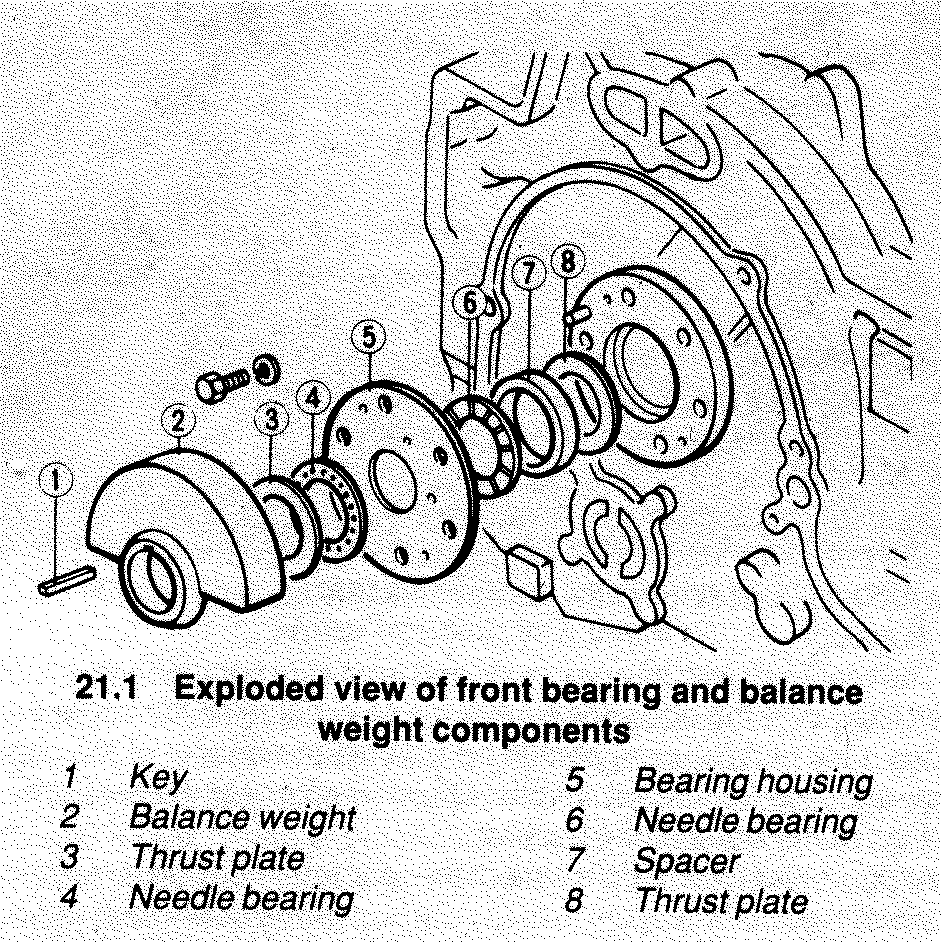
Finally,  I'm not sure if I would want all that thrust being transmitted

through a Torrington race.  It's only designed to take the intermittent
thrust of a clutch throw-out bearing!  I've seen lots of them brinnel
over
the years. I've also seen a few of these plates crack.  Mazda know all
about this,  and as a result,  they put bigger ones in the Series 6
engines!!

See,  the flat Torrington race,  by its very nature,  is not a high
thrust
device.  The outer edges of the PARALLEL rollers MUST travel faster than

the inner edges.  This means that there is a sliding action of the
roller
against the thrust plate somewhere. To properly transmit high end thrust

loads,  I'd much prefer a pair of tapered rollers.

Additionally,  all the thrust loads are being taken on the front housing

land to which the front stationary gear bolts.  It's not exactly the
strongest part of the engine!  Have REAL a close look at the front
housing,
 and especially the web that holds the front gear. Remember it is only
cast
iron!   So beware!  Like George's gearbox,  I can see metal fatigue
eventually occurring with absolutely catastrophic results should the
front
housing gear land  fail.

Feel free to post this on the FlyRotary site if you think I have a valid

point.

Mate thanks for the email,  appreciate your time.

Best wishes and kindest regards,

Leon Promet

Perry responded:

Hey Leon, thanks for the comments.  We did have some discussion
about this awhile back, after I inspected the thrust bearings.  Turns
out,
my prop only produces about 350 lbs. of static thrust, and maybe only
100 lbs. in cruise.  Maybe that's why it's working ok so far.  With a
turbo
and more hp, I may have to start worrying.

Some have suggested the front side housing can be modified for
better bearings.  Atkins has modified a 13B to take a 20B thrust
bearing.

Leon responded:

Hi Perry,

Mate I still don't like it!!  It was never designed to take 350 Lbs. of
thrust,  even intermittently,  let alone constantly!  In a pusher
config,
 the plate is held in by the bolts only. Under load,  the thrust plate
will
flex. (sort of like a really tough Belleville [conical] washer). (In a
tractor config,  the plate will basically be in shear).   Trouble is,
the
thrust plate is not spring steel,  it's case hardened steel.  They are
quite brittle.  If you hit them (with a hammer, or in a car accident),
they
crack, not bend.

Additionally,  the land to which the gear bolts in the front housing has

sharp casting edges,  and is sand cast out of SG cast iron as well.  So
LOTS of stress risers.  Stress risers plus vibration equals metal
fatigue.
 That's why race engine builders will spend hours with a die grinder
removing all sharp edges (not just to allow oil to flow back better!).
 Further,  have a close look at the amount of material holding the gear
land to the front housing?  It's got more material on the top than the
bottom (the oil drain holes).  That,  basically, is to what your life is

clinging!

Mate,  NOT a good idea to load something asymmetrical like this with a
pulsing,  vibrating 350 Lb. (or more) load axial load! Any idea of the
transients? On /off the throttle,  prop strike  etc? That is what will
do
the damage! The gear land was designed to take a asymmetric RADIAL
thrust
from the shaft (towards the exhaust ports side).  It was never designed
to
take an AXIAL load of more than say 100 Lbs., and then only
intermittently
during gear shifting.  It's all wrong to my way of thinking,  and it
scares
the daylights out of me,  just like George's solution.

I don't want to be a party pooper mate,  but have a real careful think
what
you are doing.  I really don't want to read about you in the obituaries!

Very Sincerely,

Leon

--
Perry J. Mick
Mick Duckt N7XR
http://www.ductedfan.com