Leon Promet wrote:
Hi Paul,

Thanks for the reply.  I'd never even considered the "Plugs Up" config
until I started researching homebuilt aircraft.  Being a tinkerer, I'm
going to try it in the next race car.  See we have steering boxes on the
right.  I can run the exhaust out the left side of the car where there is
plenty of room and away from the tootsies.  It also gets the turbo away
from the inlet manifold,  and balances the engine left to right in the car.
 With a decent turbo hanging off an engine,  there is a decided weight bias
on the right side.
Assume for the moment you can handle all the drain back and cooling
passage issues.
Is this a drag car or a road racing car? The distance from the
outside of the exhaust and intake manifolds to the e-shaft center line
is greater than from the bottom of the engine to the e-shaft center line.
It may not line up with the transmission input shaft. If you raise the
transmission
and engine you will raise the CG which is not a good thing for a road
racing car.
It could be a good thing for a drag car depending on the class.
You will still have to hang the turbo on one side or on top of the engine.
You cannot put it under the engine for the above CG reason.
You also need to put the turbo above the oil sump level for proper
turbo oil system drain back. Send me a scale drawing of what you have in mind
or just a sketch and I will do a scale drawing for you.
Sounds like an interesting car.
And I'd be using a dry sump anyway,  which brings me to the main issue.
 OK,  I know you are highly skilled and knowledgeable.  so a couple of more
questions please if I may about oil pickup arrangements for a rotary
aerobatic engine.

Assuming I build and RV6A,  and I want to do mild aerobatics (I'm 52 so I
don't want to do competition stuff),  what ideas do you have about inverted
flight and vertical flight oil supply.  .
You will need a complete dry sump system for sustained inverted flight.
I would have to study the oil drain back system in very close detail
but it does not look good internally for sustained inverted flight.
I'm of course very familiar with the dry sump techniques on racing rotaries
and other comp motors (I've had experience both the factory style and
Weaver Bros style dry sump pumps).  I'm also familiar with the Christen
System as used on Lycomings (I know a bloke who has a Pitts), but I am
having trouble getting my head around how to apply this to a rotary engine.
It seems to me that with  a 350 BHP turbo rotary in an RV6A  and the right
prop,  you could almost stand the sucker on it's tail.  That's OK. I can
easily devise a system for this.  However,  when inverted,  the front
counter weight will be immersed in oil which will aerate it terribly, and
the centre housing will fill up as well.  This would seem to require an
efficient dry sump scavenge system.  This then requires a swirl
pot/de-aerator container,  which is a gravity device.  The ones used in
cars obviously just won't work upside down!  So I think,  maybe I'll need
to make a centrifuge style de-aerator.  It's all starting to get too
complicated,  and I hear my the voice of one of my mentors;

"Keep it Simple Stupid!"

I'm flummoxed.  Any ideas.

Best wishes and kindest regards,

Leon Promet
This is a cut away of the center housing. The oil drain back problem does
not look
too bad here with a scavenge pump pickup on top and bottom. It is the front
housing as you say  that really gets screwed up when
the engine is run plugs up. I need to take some detailed pictures
of the front housing oil drain areas back to illustrate this.

Paul Lamar
"Ray Richardson Jr." wrote:
Hi Paul and rotary fans;

I noticed the latest interest in dry sump systems.

Powersport is currently building the dry sump systems.
for the 2 rotor engine, and the 3 rotor engine (larger pump gears)
Included are complete housings with 2 scavenge pumps and 1
pressure pump all inside the housings. This design uses helical
gears that drive all 3 pumps from the cc. shaft, (no chain)
We have them with, or with-out the distributor mounting hole
as we mount our alternator in that location.

We have not come up with the remote sump supply package
yet, perhaps someone Paul's list has a design to offer.

Ray Richardson
www.powersportaviation.com
www.ratechmachine.com
Since you are going to spend the majority of the time upright with or with
out a dry sump system I think you should run the engine upright.

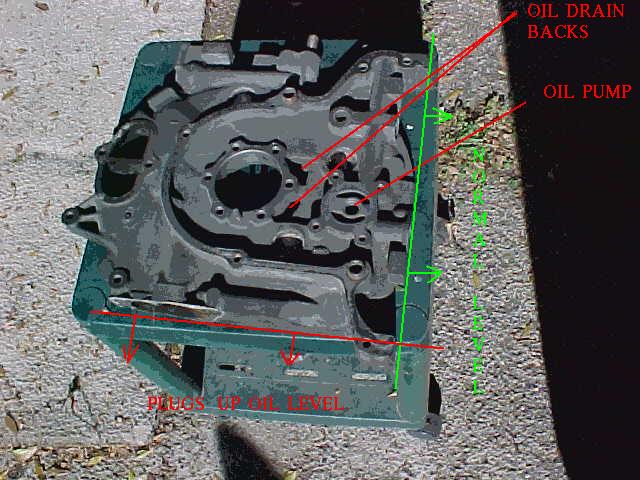
Here is a picture of the front housing with the cover off.
Notice the distance from the oil sump level to the oil pump is
much less in the normal engine upright configuration.
This means the oil pump needs to be in good shape when sucking oil up
from a lower sump in a plugs up configuration.

The amount of oil retained in the rotor
will be larger with the plugs up configuration and much, much larger inverted
due to a less favorable drain back position. This may or may not have
an effect on rotor cooling and other things. Nobody knows for sure as nobody
has instrumented the rotor for temp in a plugs up situation so far to my knowledge.
Why increase the unknowns and the risk of failure?
Since the advent of electronic ignition and a lower crank angle sensor
I can see no real reason to run an engine plugs up as the engine is
just as tall as it is wide.

On the other hand in a horizontal opposed aircraft piston engine this is not
so severe a problem as the engine is more or less symmetrical and oil
will pour out of the pistons more or less the same, upright or inverted.
An oil scavenge pump pickup located at the top of the crankcase should
then do the job when the engine is inverted.

As someone said on here, sustained inverted flight in a rotary is probably
not worth the effort and risk. Also on the other hand that is what experimental
aviation is all about.

Paul Lamar

The AirCraft Rotary Engine NewsLetter.              Powered by Linux.

http://home.earthlink.net/~rotaryeng/            http://www.linux.org