The discussion of the throttle body size reminded me of another recent topic.
 The topic of intake building and intake runner length.  This is a topic that
I've been concerned about as I begin to contemplate my 20B installation which
will begin in January.  Eliminating as much unnecessary weight as possible is
very desirable to everyone but especially once committed to a 20B
installation which pushes the limits of  the weight envelope in some aircraft
(such as my Velocity).  In addition, cowl space sometimes becomes an issue.
Thus, eliminating intake weight and as much excessive runner length as
possible makes sense to me.  This seems to be limited by performance issues.
Ed Anderson, who has a great deal of knowledge about this issue, wrote the
following: " My current intake runners are adjusted to 21" from intake port
to center of throttle! plenum.  This is supposed to be the length that
provides the Dynamic Supercharging effect for about 5500 rpm..........I can
adjust the length from 17" to 23".  He later went on to add, "At one time I
entertained making the manifold length adjustable......with the idea of one
setting (longest) for lower rpm power such as takeoff and one setting
(shortest) of max. cruise power."  These few sentences filled me with many
questions:

1)  What is Dynamic Supercharging?
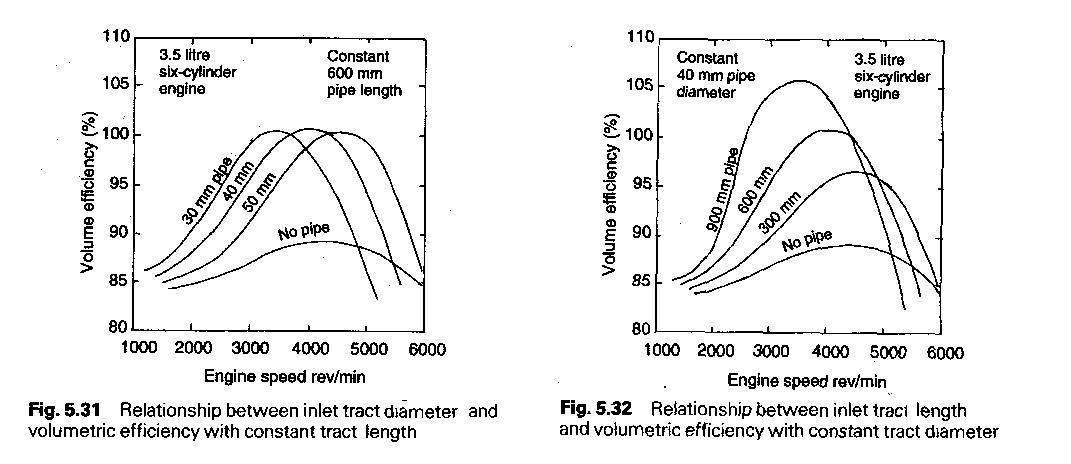
Dynamic supercharging if there is such a term is what happens in a pipe that
has pressure waves bouncing back and fourth. Just like a pipe organ.
If the RPM is such and such and the pipe is a certain length the
pressure pulse will arrive just as the intake port is opening
and the engine will ingest a higher mass of air. These numbers for
a Mazda 13B are about 6000 RPM and 20 to 25 inches of pipe length.
Since the pipe can be made out of .040 wall aluminum tubing they
don't weigh much.
2)  What is the ideal runner length for best overall performance and how does
one figure this out (or at least get in the ballpark).
See the chart below. It is done on a dyno by experiment.
As I said 6000 RPM and 20 to 25 inches long.
3) How will #2 above be effected by changes in runner tube diameter and / or
intake porting?
There is indeed a small effect from runner tube diameter and probably
a small effect from porting.
4) Will "Plugs Up" add any other considerations to this topic?
No. But I don't recommend the plugs up orientation under any circumstances.
5)  What would be the effect of turbocharging?  Would adding a turbo overcome
the complexity of tuning the intake runner length and allow one to simple
adjust boost instead?
More or less but even turbo's can benefit from tuned intake pipes. PL
Wow, my brain is already starting to hurt!!!!
Any additional information and / or discussion would be greatly
appreciated!!! I'm especially interested in information about calculating all
this out.  Damn, I knew I should have gone ahead and taken those extra math
courses on college!!!!

Thanks everyone!!!
Don Mitchell
Irving, Texas
Velocity / 20B
The AirCraft Rotary Engine NewsLetter.              Powered by Linux.

http://home.earthlink.net/~rotaryeng/            http://www.linux.org