Leon Promet wrote:
Yair G'day Paul,

Firstly let me wish you and everybody on this list a Happy New Millennium!!
 May all your flights be long and safe and enjoyable ones!

Mate,  I really respect your engineering expertise and vast knowledge, and
I don't want to get you 'off-side',  but can I ask you a question??  Have
you actually been to the Burnelli site and read through it?

All we seem to be talking about is the BWB and Northrop flying wings!!
 This has NOTHING to do with Burnelli and is NOT what he was on about.  His
seminal idea was to make the FUSELAGE a lifting surface,  instead of being
just a parasitic drag producing appendage.  He also wanted to get the fuel
away from the passengers so that in a crash, you wouldn't end up with lots
of barbecued "long pork".   Which is what usually happens with our coke
cans with wings crash!!

All of his designs,  with the exception of the 1951 Delta (which does look
suspiciously like the Boeing BWB anyway,  or is that the other way
around?),  had large vertical stabiliser devices using twin boom tailplanes
a la P38,  Vampire,  Venom,  Cessna 337,  Fairchild C119 etc,  etc.  Even
Burnelli's radical last design, the GX-888 had two huge vertical fins for
yaw stability.

Anyway,  delta wings are a known,  proven quantity. LOTS of commercial and
military aircraft are based around the delta planform. I won't bore you
with examples. However,  if Boeing choose not to use one or more rear
vertical stabilisers close to the centreline,  then more the fool them!
 Maybe people infected with Northrop philosophies have got in their ears!!
 Anyway,  the BWB looks sort of suspiciously like a bloated and blended
Long EZ or Cozy IV (without the canards! ... put deep root fairings on them
and what would they look like?? Sort of scaled down BWB???? Hmmmmmmm
...???)  The bumble bee,  Rutan,  Puffer and others fly in the face of
'conventional' aeronautics as well,  and fly well they do!!

Yeah, sure,  Edwards AFB is named after the poor bloke who crashed one of
Northrop's ill-starred designs.  Maybe they felt guilty?  But what's that
got to do with Burnelli??  On the other hand,  the only known crash of a
Burnelli (nothing to do with inherent bad design,  instability etc,  just
faulty maintenance by a sloppy mechanic) had both pilots walk away
unscathed.  Proof of concept!
Can I ask another question??  Why are we discussing the short comings of
NORTHROP's designs as IF they translated into shortcomings of Burnelli's
designs?  TOTALLY different concept!!!!  You are smearing one man's designs
with the shortcomings of another's designs!!  If Northrop had put twin
booms on his wings with vertical fins and a horizontal stabiliser between
them, (or a pair of canards on a slender snout like the EZ or Cozy) he
wouldn't have had the stability problems and Edwards would probably still
be with us.  As it was,  with the 1/3rd scale wing,  the N-9M,  he used
raised prop shaft nacelles to give it a modicum of yaw stability.  Those
nacelles weren't present in either the full size XB-35 and of course the
jet powered XB-49. It appears that Northrop had a serious problem of
'reductio ad absurdam".   C'mon Paul,  you are a smart man. Seriously,
there is NO similarity between Burnelli's concept and that of Northrop's
"pure" flying wing concept!!
Anyway,  have a nice prosperous, safe and enjoyable millennium!
Cheers,

Leon Promet
You are right Leon. I did forget the fact that the Burnelli had a tail.
OK I see what you are saying. The Brunelli has tail booms and
a horizontal tail. Touché. In a way the problems are the same. In order to get
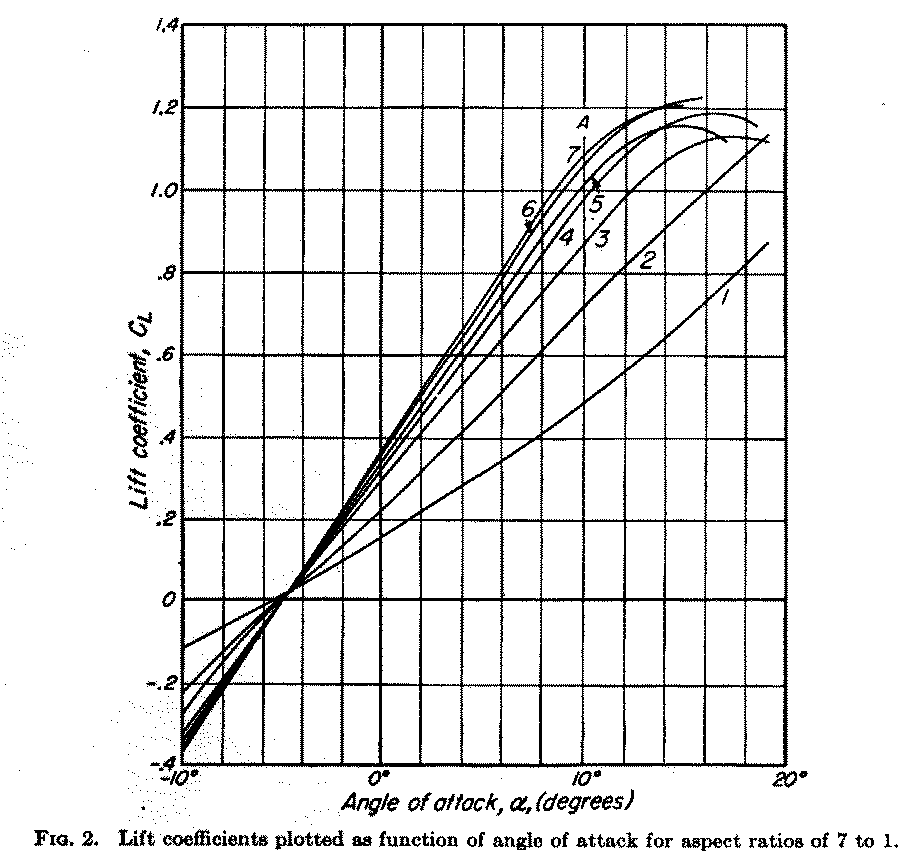
any appreciable lift out of a large cord, narrow wing span fuselage like the
Burnelli it needs to fly at a 15 degree angle of attack. If it flew at 15 degrees
the outer(higher aspect ratio) wing panels would be stalled. Obviously it is
not flying at a 15 degree angle of attack so what you wind up with is a
blended wing design with a tail and excessive skin friction drag just
like a tail less blended wing or a pure flying wing.

Here is a chart from Von Doenhoff Theory of Wing Sections for lift coef. verses
angle of attack. The Burnelli fuselage has an aspect ratio of one or less.
Aspect ratio in this case is span of the fuselage over cord of the fuselage.

In a global sense they are not as far apart as you think. If you correct
the aerodynamic errors of the Burnelli design, namely the lift discontinuities and
interference drag where real wings meet the wing fuselage, you wind up with the Boeing
blended wing design with a tail. So there is a bigger bump in the top of the Boeing
wing as compared to the Northrop XB49 flying wing. That would have little
affect over all so those two are not very far apart. You still have the
pressurization and skin friction problems if not the stability problems of a
tail less design. Also Vance brought up the ride in turbulence situation which
would be a major problem for the airlines.

Paul Lamar

The AirCraft Rotary Engine NewsLetter.              Powered by Linux.

http://home.earthlink.net/~rotaryeng/            http://www.linux.org