Stone Tool wrote:
Paul:
    I assume from the photo that these cylinders were cast with the heads
integral.    This is the way I've long felt that the VW heads & jugs should
be done for aircraft.    Both cylinders done in aluminum with the head cast
integral.    This would provide an uninterruped path for waste heat from the
head down to the cylinder fins..... any break such as the head / cylinder
mating surface creates a barrier that slows the flow of heat..... not to
mention the much lower thermal conductivity of iron.    In additon I think
that a general re-think of the valve setup with seperate little rocker boxes
and longer valve stems to allow more air flow and more cooling fin area not
to mention downward angled exhaust and intake ports would make a far better
aircraft engine.   additionally I believe that the case cold be bored
through to allow the case studs to hold the cylinder assembies down by 6
bolts along the base.....  similarly to the P&W cylinder in your photo.
This would require some custom work on oil passages as the stud holes if
drilled on through would punch through oil passages in at least one place.
Doing this would allow larger bore cylinders to be used..... perhaps 4" or
larger.....they cylinders would not need skirts projecting down inside the
case or the case clearanced for said skirts.   Longer rods would keep the
pistons up away from the case.    Chevy Rods are already common in VW
strokers.   Dowel pins could align the cylinders.    The result would be a
far stronger more rigid engine.     We already have an excellent chrome moly
billet crank available through Great Plains, and several auxiliary bearing
setups that work quite well.    The VW crank is very similar dimensionally
to the Continental A & C series cranks.    A stroked and bored Type 1 could
concievably be increased to about 170 CID or more..... about the same as the
A Continental.
    You couldn't achieve any weight savings over the Continental, but you
could  probably match it, and the Continentals are no longer available new a
nd are becoming increasingly scarce on the use market.
                                             H.W.
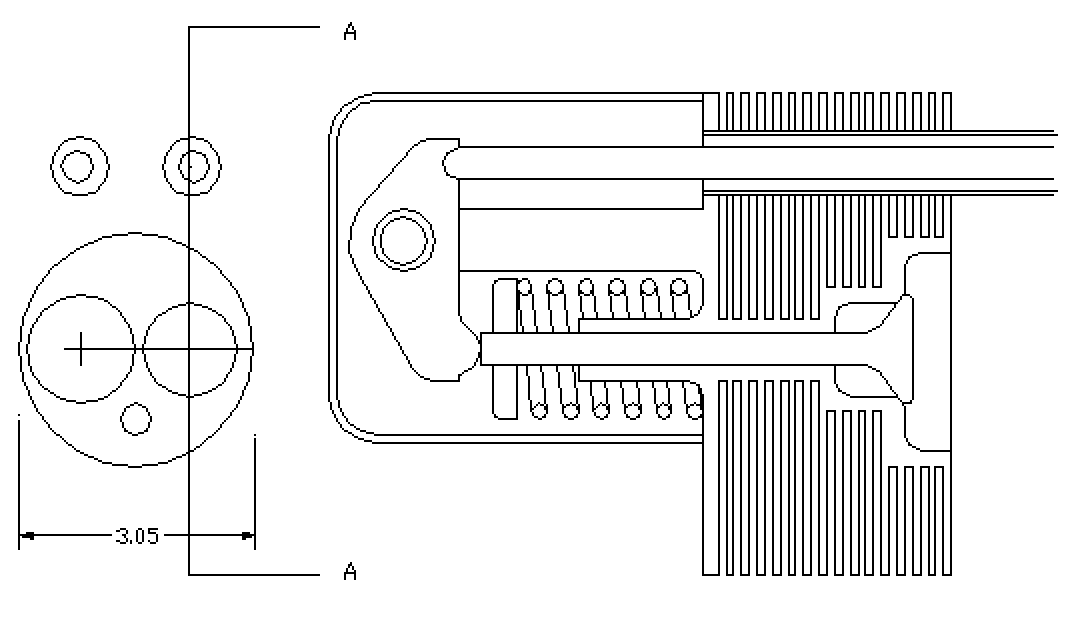
I worked up a sketch more or less to scale.
Longer valve stems and .1 fins with .1 spacing.
This is a section cut through the center line of the exhaust valve.

Paul Lamar

The AirCraft Rotary Engine NewsLetter.              Powered by Linux.

http://home.earthlink.net/~rotaryeng/            http://www.linux.org