It always amuses me when someone says an airplane is stall proof.

If you dive and pull up into a vertical climb what happens when the
airplane
stops climbing and just plain stops. Does the nose only drop 3 or 5 degrees
and start flying again or does it fall completely through to a vertical
dive or does it fall over backwards? What about the torque reaction from
the prop when the airplane is vertical and is not moving?

Paul Lamar
This situation is not a stall since the wing is not supporting the weight of
the aircraft at any speed in the vertical. A stall occurs when flow
separation at a particular angle of attack destroys sufficient lift to cause
the weight of the aircraft to exceed the lift being generated. The stall is
the same and meets the same rule for a Mig-29 and a Piper Cub. The wings
follow the same rules as conventional aircraft. Pitch authority is a function
of the distance between the center of pressure of the elevators (elevons)and
the average center of pressure on the wing. Pitch sensitivity is a function
of the distance between the average center of pressure of the wing and the
center of gravity. The greater the distance, the less sensitive. There are
some very pitch sensitive aircraft (BD-5) and there are some pitch
insensitive wings (Dyke Delta) As old as the Dyke Delta is it remains a very
efficient design. Lynn E. Hanover
That is an interesting definition for a stall Lynn.

My copy of the New World Dictionary says "Aeron. any condition in which there is such
a loss of lift  and increase of drag that the aircraft tends to drop or go out of
control."

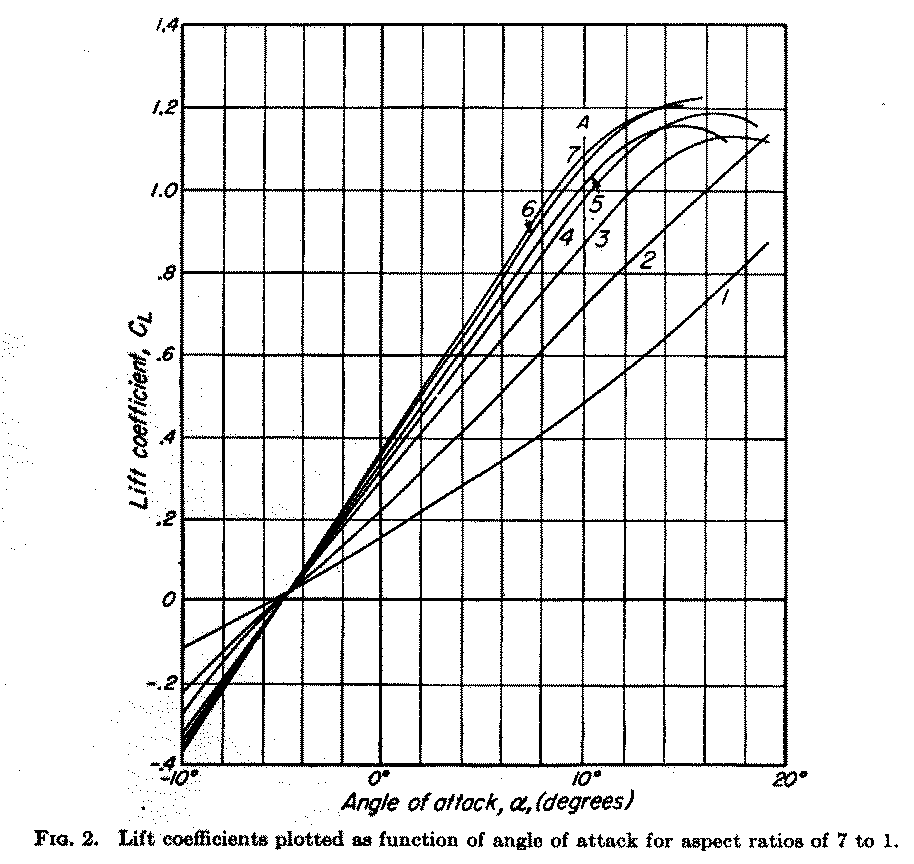
"Pitch sensitivity" is a function of aspect ratio. As you can see from this
chart.

The down side of low aspect ratio wings is induced drag.
This affects them during takeoff and climb. Most delta wings have
been over powered and design oriented towards top speed.
Just like ducted fans I might add.

The induced drag coefficient based on the wing area
is Cl^2/(Pi X Aspect Ratio).

Let me run a couple of numbers for you. Lets say we have a wing with
aspect ratio one and a lift coefficient of one. Keeping it simple.
The drag coefficient would then be 1/pi or about .32.
Let use also say we have a 100 square foot wing and the dynamic pressure
is 26 pounds per square foot at sea level at our 100 MPH climb speed.
So we have 2600 pounds of lift at 100 MPH.

Our induced drag will be .32 times 2600 pounds or 832 pounds at 100 MPH.
100 MPH is 147 feet per second so we need 122,304 pound feet per second
in the way of HP or 222 HP just to generate this amount of lift.
That is HP out of the prop so you need to add 20% or so for the
engine HP.

This does not include all the other types of drag and they must
be added in to come up with a total drag and HP requirements.
Induced drag however is by far the largest component of drag with a
low aspect ratio wing. This is kind of where the term "back side of
the power curve" came from.

BTW this is also why the car racing organization have limited
the WIDTH (span) of wings on racing cars. They want to make
them less efficient at generating down force.

Now lets look at an aspect ratio of six which is more typical.

The induced drag factor would then be 1/(pi X 6)  or 1/(18.84) or
about .053. Our induced drag would then be .053 times 2600 pounds
or 138 pounds of drag at 100 MPH. Figuring the HP 138 X 147 or 20,286 or
dividing by 550 pound feet per second for one HP gives
us only 37 HP out of the prop to generate this amount of lift.

This is all in Abbott & Von Doenhoff Theory of Wing Sections and I highly recommend
it as it is published in paper back form by Dover and you can buy it new
for $15 bucks or so. A real classic.

Paul Lamar

The AirCraft Rotary Engine NewsLetter.              Powered by Linux.

http://home.earthlink.net/~rotaryeng/            http://www.linux.org