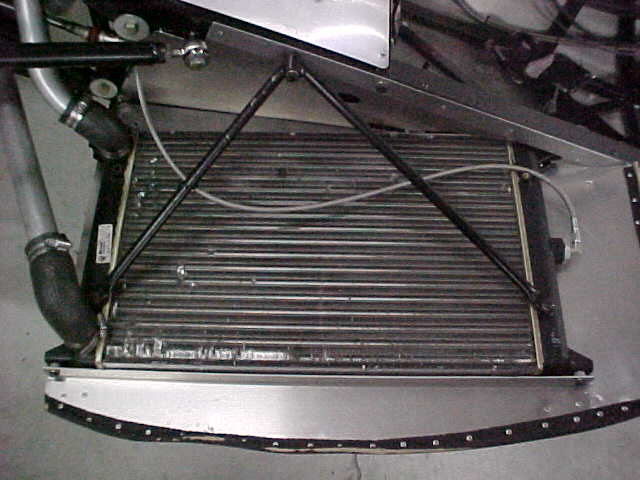
This is one of the two identical rads. It is a two pass stock VW type
complete with plastic header tanks.
It is in series with the one on the other side of the car.
The second rad in series runs much cooler than the first.
Both are mounted in enormous ducts with hardly any internal diffusion
except that they are mounted 30 degrees off horizontal.
"Hey if it don't cool put in bigger rads" :-)
All cars are the same so there is no incentive for low drag.

They run a stock 20 psi pressure cap and thermostat sometimes.
Sometimes they take the thermostat out and block
off the bypass with a threaded pipe plug.

The guys admit the engines run over 200 degrees F sometimes
as does the oil. Average race speed is about 100 mph and the
HP duty cycle is somewhat less than 100%. I would guess roughly
75% with constantly varying RPM's and HP of course
depending on the track. Some tracks can be close to 100%
for this kind of car. Say a high speed oval where the turns
are taken wide open at near peak HP RPM.

Paul Lamar
Tracy Crook wrote:
A lot of people seem to be using those Rabbit radiators with the round tube
coolant passages so I chose one for my engine test stand.  To put it mildly,
I was less than impressed.  There seems to be a relatively high thermal
resistance between the core tubes and the fins.  My coolant temps would be
in the red (210 deg F) and at the same time I could put my hand on the fins
and they felt barely warm (the end tanks were very hot so it wasn't a water
circulation problem).  Since this was a fixed ground application, the fix
was to spray the radiator with a garden hose.  Not an option in the plane of
course.

Tracy Crook
rws@altavista.net
www.rotaryaviation.com
I talked to engineer Ron at Star Mazda today and he confirmed that these
VW radiators were very inefficient. He uses them because he can buy
them for much less than $100. He says they can run one expensive efficient
radiators or two of these. Two of these are cheaper than a Fluiddyne
racing radiator. We do not enjoy that luxury as we are space limited :-)

Ron's theory on why they don't work well is; the front round tube blocks the
air flow to the rest of the round tubes behind it. With the wide flat oval tubes
in a conventional radiator that does not happen. I think Tracy has a point
as well and the heat transfer out of the round tubes into the fins is not
as good as it would be with a flat oval tube. The core of the water flowing
through the round tube remains hot. Only the water adjacent to the wall
of the tube loses its heat due to the necessary turbulence.

Paul Lamar

The AirCraft Rotary Engine NewsLetter.              Powered by Linux.

http://home.earthlink.net/~rotaryeng/            http://www.linux.org