Ken Powell wrote:
 >
 > Dave and Paul,
 > I agree with Paul on this one but for different reasons.  Of
 > primary importance here is that the main tuning effect comes from
 > the length of the tubes and the main timing of the pressure waves
 > is dependent on this length.  What is called the dynamic tuning
 > effect is not nearly as strong (or as important).  Daves
 > discussion of this dynamic timing is correct for a 2 rotor but is
 > in conflict with the length of the intake tubes when they are 18"
 > to 24" long.  Due to the event timing worked out by Dave I do not
 > see how dynamic tuning can work in a 3 rotor.  It looks like the
 > pulses will arrive at the wrong time, giving no benefit (or maybe
 > even having a negative effect).  Dave, it appears to me that your
 > logic supports this argument.  Did I miss anything or do you guys
 > agree.
 >
 > Ken Powell
Thanks Ken, that actually clears it up for me.  I was beginning to suspect
that what I thought was the major effect in tuning (what you call dynamic
tuning) was really just a minor effect.  I guess the more important effect is
due to some sort of harmonics within each individual runner.  Given that this
is the more important effect, then I agree that the tuned length for a 20B
would be the same as on a 13B.  What do you call this effect, static tuning?
How is it calculated?  My guess is that it would be based on standing wave
equations.  Unfortunately, I threw away all my college physics books when I
went to medical school (and had to move every 6 months).  I suspect, though,
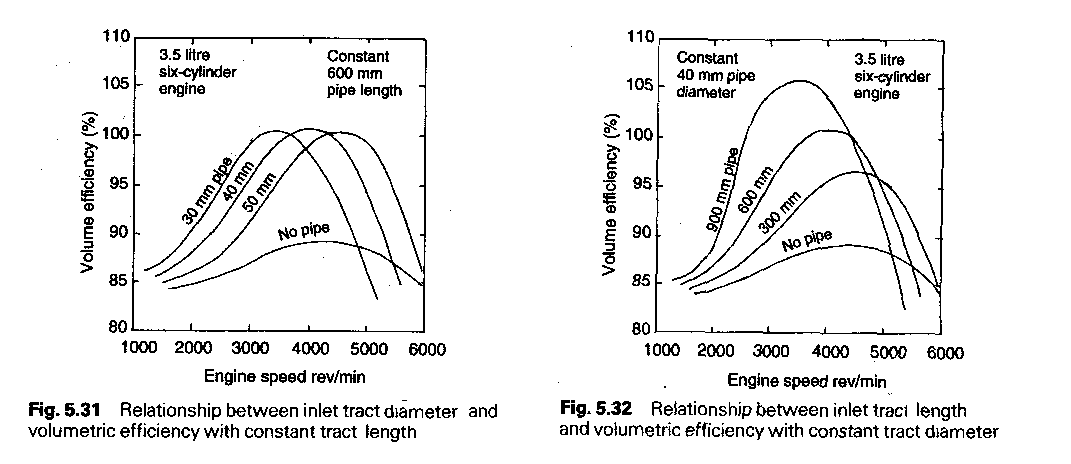
that for a standing wave both the length and diameter of the runner are
important.

Dave Leonard
True Dave. Keep the diameter up to reduce the skin friction in the pipe.

Paul Lamar


The AirCraft Rotary Engine NewsLetter.              Powered by Linux.

http://home.earthlink.net/~rotaryeng/            http://www.linux.org