snip
Vance, I was just objecting to the term "stalled", as in a wing being
stalled (air separation and generating little or no lift. I felt that it
was being interpreted as the prop had entered a "dead zone" which I don't
believe is the case. I suspect that it is similar to a cavitating boat prop
in that the fluid (water) is unable to move fast enough to fill the void in
front of the prop, and a vacuum is formed. In this case,it's just very thin
(i.e. high altitude low pres) air in front of the prop and compressed air
behind it. It is still making thrust (lift), or the engine would over-rev.
Just semantics, I think.

Chuck Harbert
  Chuck,  a stalled prop still makes a very substantial portion of the
"unstalled"
lift, but it also make a LOT more drag.  The L/D goes to hell (why the airplane
drops at stall), but the lift is perhaps 50-80% of peak depending on the angle
of attack, airfoil etc.  Cavitation is caused by the boiling (phase change)
of water
due to low pressure on a prop or impeller and is impossible in an all-gaseous
medium like air, so is very inappropriate.  Any high speed cruise fixed pitch
prop is partially stalled at static, this is essentially certain.  They
generally
smoothly unstall as the plane accelerates.
I believe this accounts for the relative speed insensitivity of my Long EZ's
rate of climb.  The ROC at 90 kts is nearly identical with the ROC at
110 kts, with 110 possibly higher ROC, it sometimes seems.  The prop is
getting a lot more efficient as the plane accelerates and this can partially
(or more than?) make up for the extra power required to maintain the
higher speed.  Climb rate is controlled by the 'excess' HP available above
what is required for steady state cruise at the climb speed.  So, it takes
more thrust to go faster, but ---  the engine is winding up higher on its
power curve and the prop is getting more efficient, so - some more engin
HP plus a more efficient of that more HP into thrust . . . .  I have a very
flat ROC vs speed curve.

Bill
In other words the rate of climb is a function of the ratio of HP out of the
prop verses the overall drag of the airplane and its weight. Drag at speed is
another way of saying HP. One HP is 550 pounds of drag moving at one foot per
second or 55 pounds of drag moving at 10 feet per second. It is also lifting
550 pounds of weight at the rate of one foot per second.

So how fast an airplane climbs in feet per second depends on the HP out of
the prop minus the drag HP at that speed divided by the gross weight of
the airplane in pounds. The net HP is lifting the weight of the airplane.

HP out of a fixed pitch prop increases with speed up to the design speed of
the prop. Paradoxically there is no HP out of a prop at zero speed despite
the fact the prop is generating thrust. This is an outgrowth
of the way HP is defined. HP is a force moving at a speed.

The curve of HP out of the prop verses speed is not always smooth.
A stalled prop at low speed will have less HP out than an unstalled
prop at the same speed. In that case the thrust is less.  As the
speed builds up and the prop becomes un-stalled there
will be a more rapid increase in HP out.

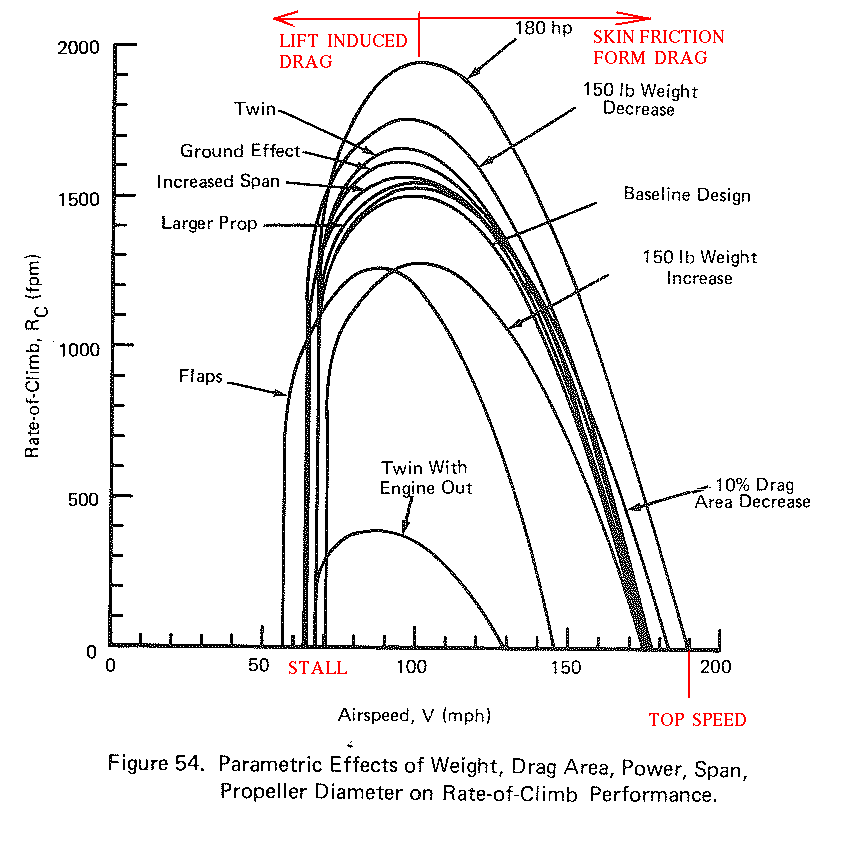
Airplanes have a minimum drag speed around 100 MPH or 147 feet per second.
This varies with the design. Below that speed induced drag due to lift predominates
and rapidly rises as the aircraft slows toward stall speed. Consequently
the rate of climb falls off rapidly as does the HP out of the fixed pitch
prop. Above that minimum drag speed, drag increases again due to skin friction
drag and form or shape drag. Climb speed falls off despite the fact that
HP out of the fixed pitch prop is increasing because aerodynamic drag
is also increasing faster. BTW this is the only part of the curve
where the term "equivalent flat plate area" applies when
calculating drag.

When the airplane can no longer climb it has reached top speed
or its altitude ceiling. In other words it must slow and or descend
to gain the excess HP needed to climb. An analogy with a race car
is when the acceleration drops to zero the car has reached its top
speed.

This is a chart from Don Crawford's book A Practical Guide to Airplane
Performance and Design. It is for a 150 engine HP airplane with
some base line design and gross weight. I have added a few comments
to the chart in red. Its all here in this chart.

Paul Lamar


The AirCraft Rotary Engine NewsLetter.              Powered by Linux.

http://home.earthlink.net/~rotaryeng/            http://www.linux.org