Ken Powell wrote:
Hi Paul,
   We have many new guys on the list and I just wanted to share the research
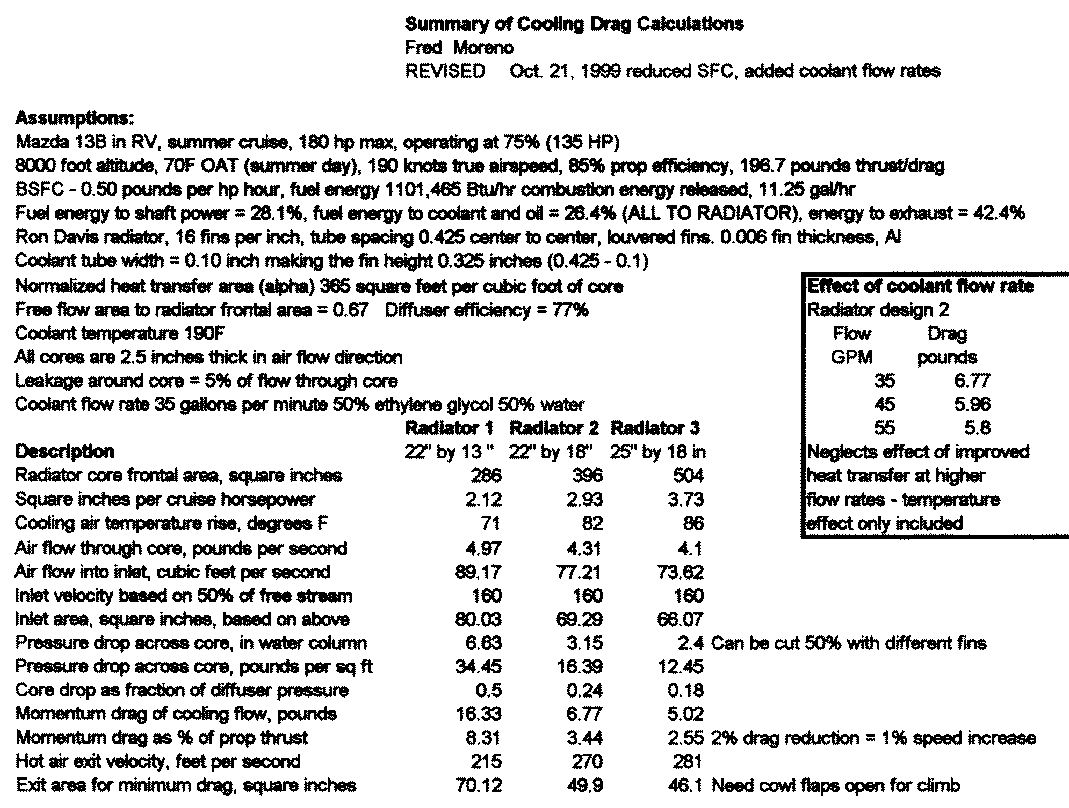
done by Fred Morino's research for Mike Wills.  I have attached the body of
Fred's paper for everyone's review.  Note that this was for a speed of 190
knots, which would be a fast RV-4 indeed!
    Mike Wills summed up this report very well:   "The real value in the
stuff that Fred sent was in highlighting the value of decreasing rad
thickness and increasing rad frontal area to reduce drag...  I think all 3
examples used the same core thickness (2.5 inches?) to graphically display
the advantage of increased rad frontal area when it came to reducing drag.
Go down in rad size and you need to dramatically increase airflow (and drag)
with larger inlets and outlets. So this in fact highlights the advantage of
large frontal area thin rads over small thick rads... It wasn't until after
I'd seen this data that I finally appreciated what a dramatic difference
there was in a thin rad with large frontal area compared to a thick rad with
small frontal area.  As I recall the specified radiator, inlet sizing, and
outlet sizing for all 3 examples would provide sufficient cooling during a
90 kt climb if cowl flaps were open during the climb."
     Mike also had this to say:  "The other significant detail in the chart
that relates to the drag number is the inlet and outlet size... The next
question most folks ask after how big should the radiator be is how big
should the inlet be."  The attached graph answers this question.

     Also note that one of the assumptions for this report was the use of
a water-oil heat exchanger so all of the heat load gets dumped through the
radiator rather than dumping the oil heat thru an oil cooler. If using a
conventional air-oil cooler the inlet and outlet dimensions given as well
as the core sizes for the 3 examples should be distributed across the
radiator and oil cooler in a 66/33 split.

This is the radiator sizing chart that Fred used: Radiator Size (core)
-

        22 x 13 x 2.5       22 x 18 x 2.5    25 x 18 x 2.5
        186 sq in           396 sq in        450 sq in
        715 cubic in        990 cub in       1125 cu in
 drag = 16.33 lbs           6.77 lbs         5.02 lbs  (at 190 knots)

Bigger is better and it seems to reason that a big thin radiator will cool
in a 100 MPH climb better also.


Ken Powell
The AirCraft Rotary Engine NewsLetter.              Powered by Linux.

http://home.earthlink.net/~rotaryeng/            http://www.linux.org