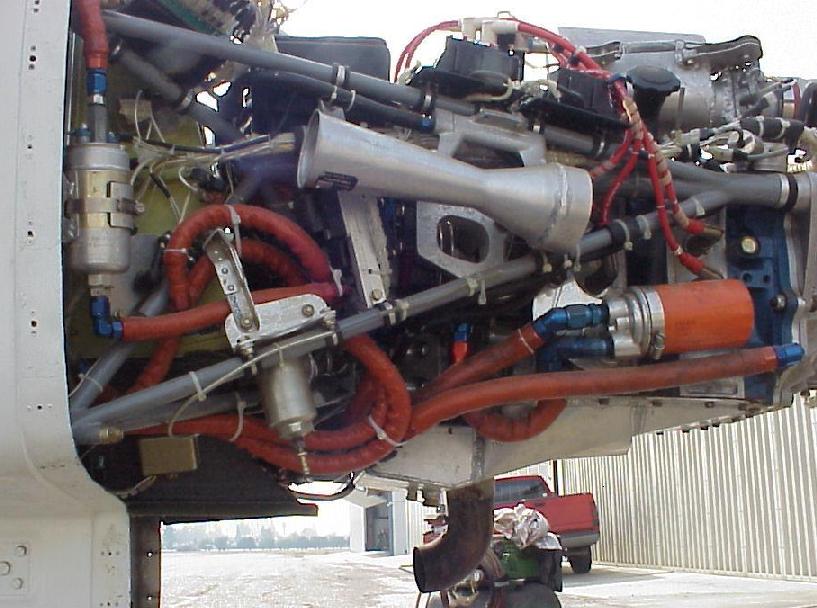
THE passenger side of the engine is shown in this photograph. Above is the venturi. Combined with intake manifold vacuum the system drives the gyros. A single hose coming from the vacuum regulator through the firewall is tee'd in the engine compartment. One side goes to the intake box and the other goes to the venturi. Check valves in each T line assure only the side with the greatest vacuum feeds the vacuum Instruments. On the test stand I could not see a change on the vacuum gauge when switching from one source to another. On the plane there may be a short time in which the venturi does not take over after pushing the throttle forward. Have not been able to test it yet.

The venturi is fed via a NACA scoop on the side of the cowl and a scat tube.The exit to the venturi goes into another duct which exits the cowl. The exit is in a low pressure area on the side of the cowl. A mock up on the test stand worked well. The vertical cylinder on the firewall in the center is the electric fuel pump. This is a standard BOSCH unit. It has a built in check valve.A engine driven fuel pump would work as well if it could out out 75 PSI. Behind the gascolator is the fuel flow measuring unit. It measures fuel into and out of the engine. They are then subtracted digitally to get fuel used. I could not finda fuel flow sender which was double light or inexpensive.
I ended up making my own. The oil pan is the odd shaped aluminum object in front of the turbo outlet. It is biased towards the rear so that oil pickup will occur at nose high attitude.The nose gear box is bottem left. A continuation of the box along the outside bottem of the cowl feeds air to the radiator. The inlet to the back side of the radiator can just be seen behind the oil pan. The black rectangular box above the venturi is the air filter. Visible on the airbox is the throttle spring. It OPENS the throttle. The throttle cable closes the throttle. A better way would have
been to use a push pull cable. I could not make one work with the tight bends the cable made. too much friction.

Chris

The AirCraft Rotary Engine NewsLetter.              Powered by Linux.

http://home.earthlink.net/~rotaryeng/            http://www.linux.org