David, you might have missed the email in which I said that the oil cooler
I got from Griffin was not made by them. I have a water radiator from them
and it is good construction. Al Geitzen had them make an oil cooler that
looks good. I think Griffin "makes" good radiators, but they do sell
another manufacturers oil cooler that is inadequate for aircraft
application.

I just saw something that I think might work well for turbocharged engines
running high boost (at higher altitudes). Lotus get's 300 hp out of a 2.2
liter (134 cu.in.-4 cyl) engine by running 15 lbs of boost. I use about 11
degF per lb of boost, so that would be adding 165 degF to the incoming air
temp. This is too much temp increase, and since they didn't have room for a
big air to air (a/a) intercooler, they built a seperate water (glycol)
system to cool the incoming air ( aka charge cooling (CC)). It's basically
2 water to air radiators and a small pump. Very compact and efficient. I
tried figuring out how to get enough room and airflow into an intercooler,
but gave up. I think I could have done it with a separate CC system because
of the smaller radiators and just running small hose, not big air tubes.

I wonder if there are advantages of CC over a/a intercoolers. Anybody have
any experience with these?
  I think you will find that for aircraft use, the extra "layer" in the
charge cooling
loop of using relatively hot engine coolant will cost efficiency and is also
another point of failure.  I don't know, but perhaps the reason Lotus uses a
liquid cooled intercooler is a packaging issue.   It would seem pointless to
"cool" your incoming charge with 195F engine coolant.

Bill
Long EZ builder & pilot
mechanical engineer
I think you missed the separate system bit Bill. Just like a P51 there was an
entirely separate liquid cooling system for the intercooler. Had nothing to do with
the engine main cooling system. This allows a packaging advantage in that the intercooler
is of much lower volume.  A lot of drag racers are using this trick as
you can circulate ice water from an auxiliary tank through the air to liquid
intercooler. Jim Mederer at Racing Beat used this trick on the three turbo (one
for each rotor) three rotor engine about 700 HP used to push a stock bodied RX7 to
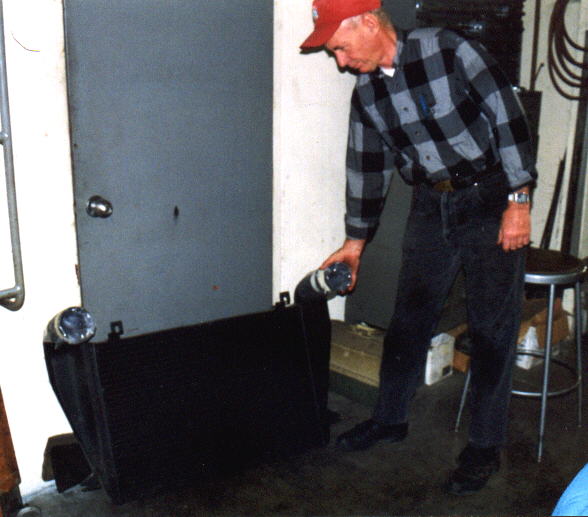
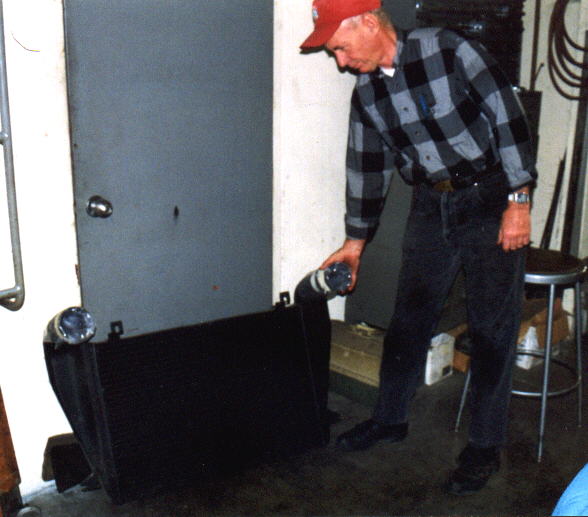
268 MPH at Bonneville. The picture is Jim Mederer holding the air to air intercooler
required with a 900 HP turbo three rotor.

There is some speculation in Reno Sport Aircraft racing circles that acetone coolant
with dry ice would work even better in a liquid to air intercooler.

Paul Lamar

The AirCraft Rotary Engine NewsLetter.              Powered by Linux.

http://home.earthlink.net/~rotaryeng/            http://www.linux.org