Will the 4mm ceramic apex seals solve the knocking concerns?

Just wondering
Chris
I don't think so. Ceramic seals are brittle and can be broken with
finger pressure alone. I personally am going with Hurley Engineering apex
seals as they are softer and probably tougher than the Mazda cast iron or
ceramic seals not to mention a whole lot cheaper.

Paul Lamar
Mark Steitle wrote:
A non-rotary friend (of which I'm working on converting him to rotaryism)
recently mentioned a space-age substance called carbon-carbon as a possible
choice for apex seals. If I understood him correctly, it is made by baking
carbon-fiber/epoxy at very high temp, then re-coat and bake it again until
you have a chunk of carbonized material big enough to make a part from. It
is supposed to be very low friction, durable and stand high heat
applications very well. Because of the labor intensive nature of the
manufacturing process it is rather expensive for fabrication of large parts.
But, considering what we pay for apex seals, it could prove cost effective
for rotaries.
Anyone have any experience with this material?
 Mark Steitle
No personal experience, but it is basically carbon fibers in a carbon matrix,
made ( as you report) by filling the carbon fiber preform with a liquid that
carbonizes when heated and repeating until the desired carbon matrix density
is reached.   Pretty expensive.  The main application I know of is aircraft and
racecar brake disks.  Also some of the hottest parts of the shuttle leading
edges and nose.  Very light, strong and heat resistant.

Bill
Long EZ builder & pilot
mechanical engineer
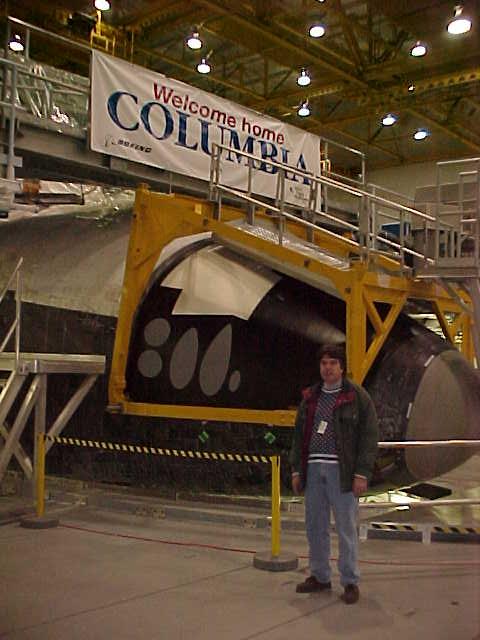
Carbon carbon nose cap on the shuttle to the right of Perry Mick.

Paul Lamar

The AirCraft Rotary Engine NewsLetter.              Powered by Linux.

http://home.earthlink.net/~rotaryeng/            http://www.linux.org