BTW I haven't got a final price on the rad yet, but the initial
estimate including
AN fittings but not the mounting tabs on each corner that I want
added is $675.00.  That sounds fair to me, but it is a strong
argument for the $5.00 evap cores.  Jerry
My recommendations are: stay away from the evap cores.
IMHO they are too thick for good cooling at low takeoff and climb
speeds not to mention excessive high speed cooling drag as just pointed
out by Ken, Mike and last but not least Fred Moreno.

Tracy's evap core's work, sort of, because he uses a water dribble
system on the ground, an obscene looking rad air inlet (:-)) and he
rarely
climbs out over 10,000 foot mountains. IMHO he would be going
210 MPH if he had lower cooling drag. He choose a conventional rad
for his new 20B RV8. Paul Lamar
Tracy wrote:

Sort of?  The dribble water system has been gone for two years, I cruise at
12,500 whether there are mountains under me or not and I'll challenge ANY
spam can (certified) single recip engine aiplane to a climb contest in any
(VFR) weather.  Sure, I'd cruise faster if I had lower cooling drag and it
probably would be lower if I had an optimised radiator.  But Jerry's point
(I think) is that getting 95% of the performance for 1% of the cost is
pretty appealing.
Now about that obscene inlet :).  It is pretty bad but that was due to the
choice I made 7 years ago to split a single cooling inlet between two heat
exchangers (one rad and the oil cooler). It is difficult enough to properly
diffuse the airstream to a single exchanger so I would reccomend against
trying to split it to two.  This is one of the main reasons I'm going with a
single rad on the -8.  The other is because I've got a lot more cowl  room
than the -4 had.  For cost reasons, I'm using an off-the-shelf Griffin
rather than a custom.  I did go with the thickest stock rad I could find
(2.625") since Fred's analysis was a nice bit of work that indicated that
this was close to the optimum value.

Tracy Crook
tcrook@rotaryaviation.com
www.rotaryaviation.com
Fred did not check max power cooling at 100 MPH climb speed.
The dynamic pressure is one quarter (0.18 psi) of what it is at 200 MPH
(0.72 psi) where Fred checked the cooling.

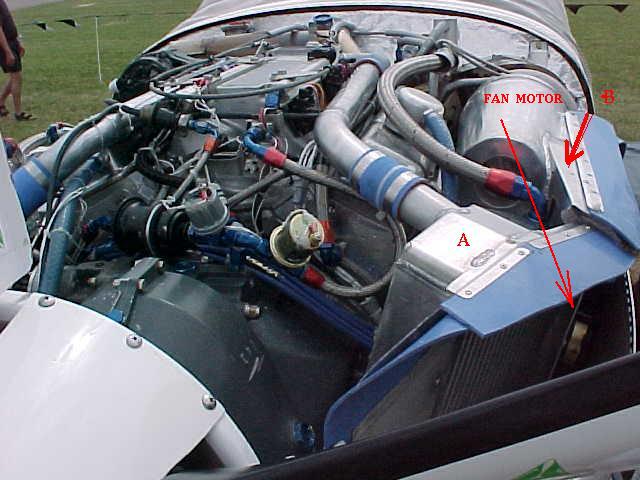
Fred's other design, the EngineAir LancAir IV requires cooling fans
for hot day climb. See the picture below. A is one of the dual intercoolers
with the water radiators on around behind them. The arrow points to the
electric fan. A simple wedge diffuser is used with the lower cowling forming
the outer walls.

2.625 thick will probably work, perhaps marginally at climb without a fan,
but why risk it when you have plenty of room for a larger area thinner core?
You can cut the drag at high speed with cowl flaps.

We are now down to arguing over the last 5% :-) A good sign :-)

Paul Lamar

The AirCraft Rotary Engine NewsLetter.              Powered by Linux.

http://home.earthlink.net/~rotaryeng/            http://www.linux.org