Bob, I'm going to guess that the heavier aircraft will glide further.
PE=mgh, so it has more stored energy to be converted to kinetic energy
as it
glides.
Yes, but KE = 1/2 mV^2, so the mass is in both terms and just drops out.

David
Yes and that is why it is important to have your Fowler flaps down when you crash :-)

Paul Lamar
I am going to weigh in on the "same distance" side.  Only because we spent 1/2 a day
debating this very problem in U.S.A.F. aerodynamics class.  However, for the "same
distance" to be true, you would have to have a no wind, no turbulence, "theoretical only"
set of external variables.  Both aircraft would immediately have to slow to and maintain
best L/D Max airspeed (differing only very slightly with weight)... clean (sorry, Paul)
and stay at that speed until ground contact.

Time of arrival would differ, but distance would be the same.
Hey, I said nothing about glide. Just crashing.
I think we have established that 747s glide well what ever the weight.
The question is; What is the best glide speed and do you want to crash
(or land for that matter) at the best glide speed? I think not. KE=MV^2

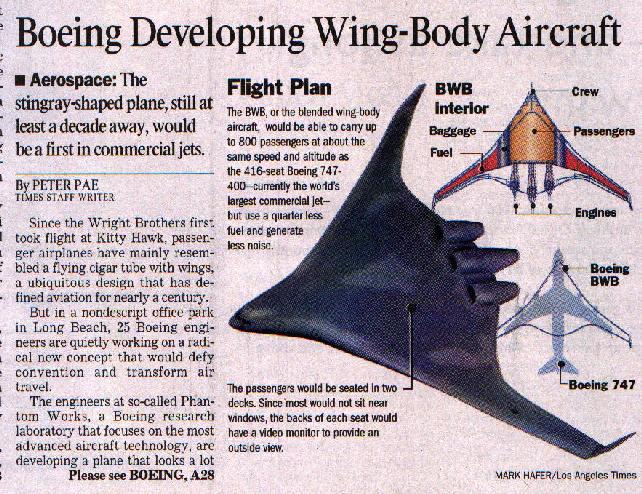
My point is it is near impossible to use Fowler flaps on a flying wing.
Fowler flaps double the lift coefficient and slow the the stall speed greatly.
The CP moves way aft when the Fowler flaps are down requiring a huge compensating
pitching moment. This allows a high wing loading for good ride at high speeds
and still a low stall speed.

Note: the difference in the distance from CG to elevator of the 747 compared to
the distance from the wing tips on the BWB to the BWB CG. Putting Fowler
flaps on a BWB and deploying them IMHO would cause it to tumble.
Twisting the wing tips reduces the lift contribution from that part
of the wing area further raising the stall speed. The bottom line is
flying wings are too much of a compromise and lack aerodynamic
control flexibility. Having a military pilot riding around in one
is different than a bunch of pax.

Paul Lamar

The AirCraft Rotary Engine NewsLetter.              Powered by Linux.

http://home.earthlink.net/~rotaryeng/            http://www.linux.org