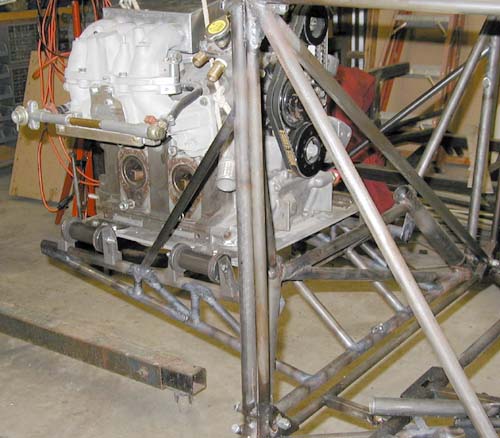
Jerry Hey wrote:
Hi Paul,  I spent the last two days building my engine mount.  I
failed to achieve my goal which was to keep all the structure below
the engine.  When I placed the engine on the mount, it sagged
downward nearly .25".  If I were to do it again, I would factor this
in.  I pulled the engine back off and put in the top braces.   Seems
to be solid now.  Only about half of the welding is completed at
present.  I'm sending several photos.  You probably will not want to
use them all. The vibration dampers were made by inserting a 3/8"
I.D. hydraulic  hose inside of a 3/4" hydraulic hose which it fits
perfectly.  The result is a 1.25" O.D. rubber bushing with a  .375
hole.  This is inserted in a piece of 4130 bored to exactly  1.25
i.d.  The rest is made clear from the pictures. ( I got this idea
from Jess Myers)  I could have done a better job making the dampers
as well......oh well.  Maybe I will do them over.    I made
everything myself for less than $10.00.

In the photo the engine is just setting there, the attach brackets
are not welded in place.  This leaves me the ability to move the
engine forward or back 2" from its present position. I still have
unresolved c.g. issues with the fuselage rad.  The engine hoist is
just for security. It is not holding any weight.
Jerry
The compressive load on the lower member joint (original configuration) I would
guess to be about 600 pounds static and 3600 pounds on a 6 G landing or pull up.
That amount of load needs to go into a cluster joint and not in the middle
of a transverse tube. Same goes for the upper member. Looking at the pictures
I would guess those two members are only six inches apart back near the firewall.
The CG of the engine is roughly two feet from the firewall. Assume the total
engine/PSRU/prop/starter/alternator weight is 300 pounds. So the total bending
moment is 24" X 300# or 7200 inch pounds. Each side handles half. Dividing by
six inches gives the compressive load in the lower joint and tension load in the upper
joint of 600 pounds. Of course your fix drastically improved the situation. It
is always best to weld motor mount tubes into a cluster of tubes and not into
the middle of a tube when doing motor mounts for space frame based fuselage's.

This picture illustrates the point best.

Paul Lamar

The AirCraft Rotary Engine NewsLetter.              Powered by Linux.

http://home.earthlink.net/~rotaryeng/            http://www.linux.org