Paul,

The bearing area on the shaft is 1.314".  The bolt pattern on the hub is 4".
I believe an SAE 2 hub has a bolt pattern of 4.75" and is standard on
Lycoming 320/360 engines.  Do you feel the housing thickness would be
adequate for the 200-250 hp range that would be available with the 13B?  As
I mentioned earlier, I would feel better using a larger diameter shaft.
(1.75-2.00")

Dave Kuc
Me too on the shaft but that would require a larger housing.
The housing looks plenty strong enough for that shaft but the flange at only four
inches in diameter will have problems with wood props.

Since you have to make a housing and flange anyway it seems like you
should start from  scratch. Do you have a machine shop at your disposal?
Here is my suggestion for a PSRU. The external braces cut the weight
of the housing and stiffen it up. You can get a six pinion housing from
John Moran as he is building them for Tracy Crook. Might be a good idea if you are
planing 250 HP. The flange shown can be enlarged to the 4.75 bolt circle.

Paul Lamar
vjaqua wrote:
The SAE 1 prop flange was allready too small for a wood prop on the O-200, and
anything over 100hp should consider the SAE 2 with 5/8 drive bushings as a minimum.
The Lyc 360 recommends the SAE 2 with 3/4 drive bushings and 1/2 in bolts, and a 7
inch flange OD for wood props.  This is highly driven by the severe pulsing of the big
four cyl engines. With your smaller, geared, six cylinder rotariesm  :-)  , this is
less critical because of the smaller pulses with greater overlap - Vance
Thanks for clarifying the SAE flange/wood prop  situation.

It is not a six Vance. Shame on you for confusing our new readers :-)
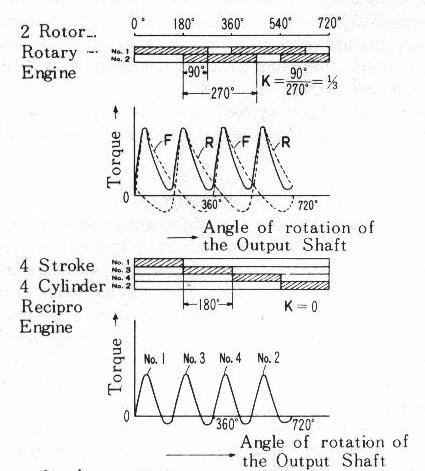
You know there are only two torque pulses per revolution just like a four
cylinder four cycle piston engine. However the two rotor torque pulse does
not go negative or back up twice per rev like a four cylinder piston engine
does. Since the HP and RPM is the same the average torque at the prop is the same.
The torque pulse peaks being a bit lower on the rotary.

The doted line represents each rotor so a one rotor engine would go
negative. I think this is a big drawback to a one rotor aircraft
engine.

Paul Lamar

The AirCraft Rotary Engine NewsLetter.              Powered by Linux.

http://home.earthlink.net/~rotaryeng/            http://www.linux.org