Dr. Moller
Here is an old message from the newsletter that might interest
you.

Paul Lamar

Subject:        KISS the PSRU goodbye with a ducted fan?
   Date:        Thu, 20 May 1999 12:11:56 -0700
  From:        Paul <rotaryeng@earthlink.net>
    To:        zz <rotaryeng@earthlink.net>
Paul wrote:
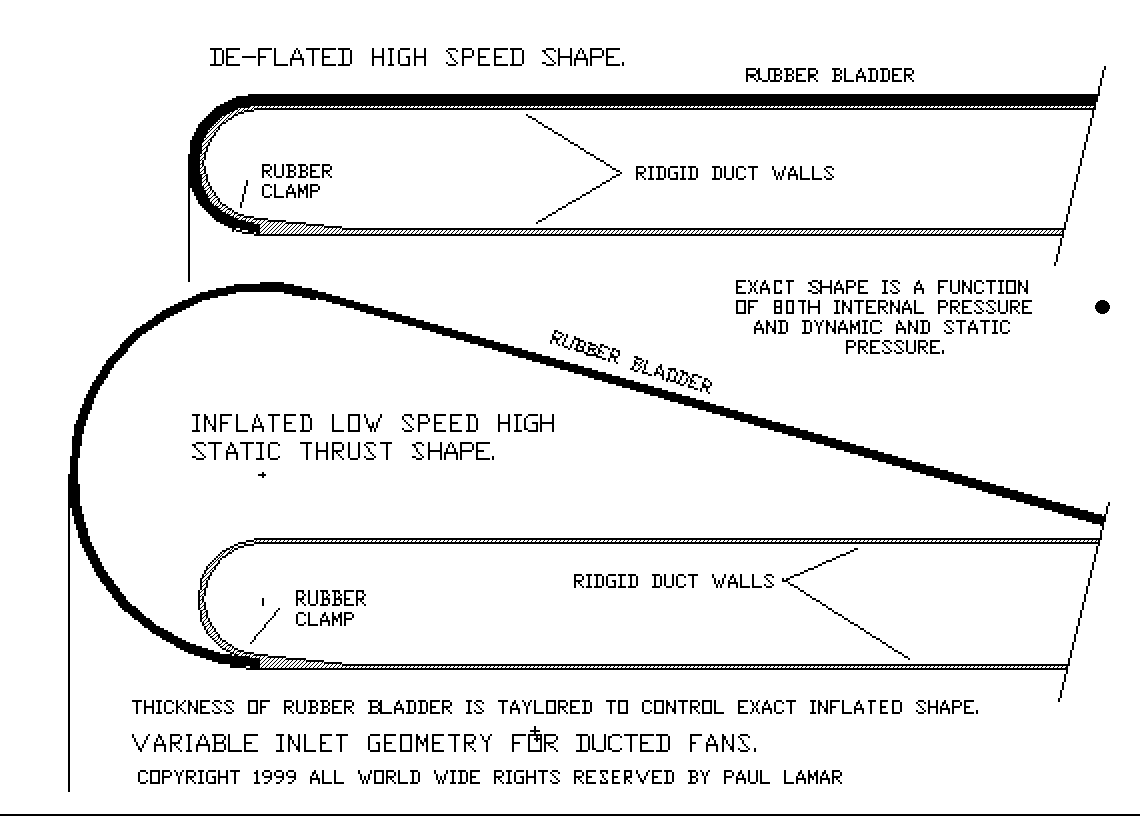
It occured to me Perry that an some sort of inflatable lip around
the duct entrance  would improve the low speed thrust and could be
deflated to reduce the high speed drag.
The duct inlet, fan-plane, and exit areas are designed to be optimum
at 200 mph.  The question is, do I have the HP and low enough drag
to get to that speed.
Perry
That is always the big question with the ducted fan Perry.
Usually what happens is the duct adds enough high speed drag to
counteract its advantages at low speed. It is not a "broad band
device" to borrow a term from electronic communications.

Your duct is obviously designed for low speed thrust
because of the large inlet lip radius. A low pressure
is developed on this lip that adds to the thrust at
low speeds. At high speeds the lip adds to the drag.

A turbofanjet duct is designed for low drag at high speeds
sacrificing low speed thrust with a small radius inlet lip.
What would  be ideal is a duct that can change shape with speed.

Even if it could change shape it may still have more drag
than a larger diameter slower turning propellor at high speeds.

Obviously with  180 HP rotary, PSRU and a conventional propellor
on a Long-EZ you would have more than enough HP and a low enough
drag to get to 200 MPH.

There is still the situation of the direct drive  small
diameter prop fan running at the same RPM. Perhaps a duct
is better in that situation.

The question is; will that duct add a lot of drag at
high speeds to prevent your getting to 200 MPH?

The answer, so far for most ducted fans that have been
tried, is; yes... it will add a lot of drag.

I would be curious to know the acceleration of your airplane.
If you could put an observer in the back seat that could
record  the length of time it took to accelerate to distance
markers on the side of the runway on a calm day I could
calculate the  thrust knowing the gross weight
of your airplane. I would do this with several taxi runs.
First to say 100 feet. Than the next run to say 200 feet
and so on until you built up a table of time to distance.

The aero drag and tire rolling resistance can be factored
in to get an estimate of low speed thrust as a function
of speed. You might also tow the airplane at low speeds
with a spring scale to measure the rolling resistance
which will add accuracy to the thrust calculations.

This is what the Rutans did with the Voyager to determine
if it would take off at gross weight.

Paul Lamar

The AirCraft Rotary Engine NewsLetter.              Powered by Linux.

http://home.earthlink.net/~rotaryeng/            http://www.linux.org