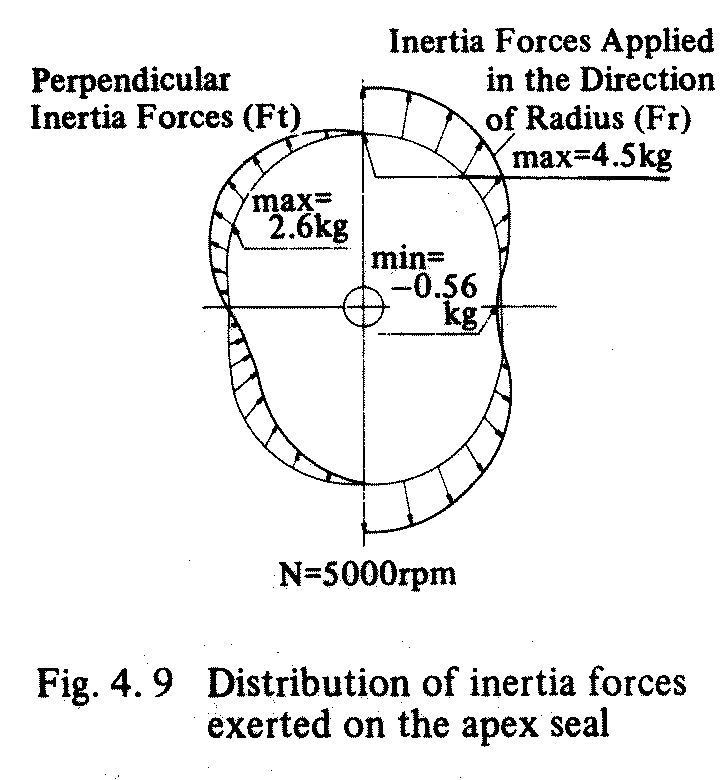
I was checking the book on the acceleration of the apex seal
to prove that Vance's piston wankel would not run and it occurred
to me why it is important to keep the apex seal weight as low
as possible.

I was stunned to notice that a one ounce or so Mazda
apex seal weighed 4.5 KG or almost ten pounds at 5000 RPM when it is
at the top and bottom of the trochoid. Also it goes negative right over
the hump and tends to jump back in the slot just when you don't
want what Mazda calls "spit back". Spit back is a leakage of hot
gases that cause the following chamber to pre-ignite or detonate.
This, and weak apex seal springs are what causes that black spot right
after the hump on the combustion side of the trochoid.

A subtle point. There is a line contact between housing and
apex seal so the pressure in this line contact is a function of the seal
weight. If it were not a line contact but a simple flat surface contact,
with the wide seal the pressure would stay the same as the area of
contact would also increase. Higher pressure.. higher wear!
Also the seal tends to rock back and fourth in the slot due to these
inertial forces causing wear on the sides of slot and seal.

IMHO these are also some of the reasons Mazda went to a 2 mm apex seal
instead of a three mm or wider seal. Better wear characteristics and
less spit back.

Awhile back I suggested drilling a series of holes in the back side of the 3 mm seal
to reduce the weight without fully appreciating why. The 3 mm seal is worth
keeping because it is tougher and more fracture resistant than the 2 mm seal.
With turbo charged engines under detonating conditions this becomes very important.

Emon, please set up and do this with an NC mill. I will pay extra :-)

Paul Lamar

The AirCraft Rotary Engine NewsLetter.              Powered by Linux.

http://home.earthlink.net/~rotaryeng/            http://www.linux.org