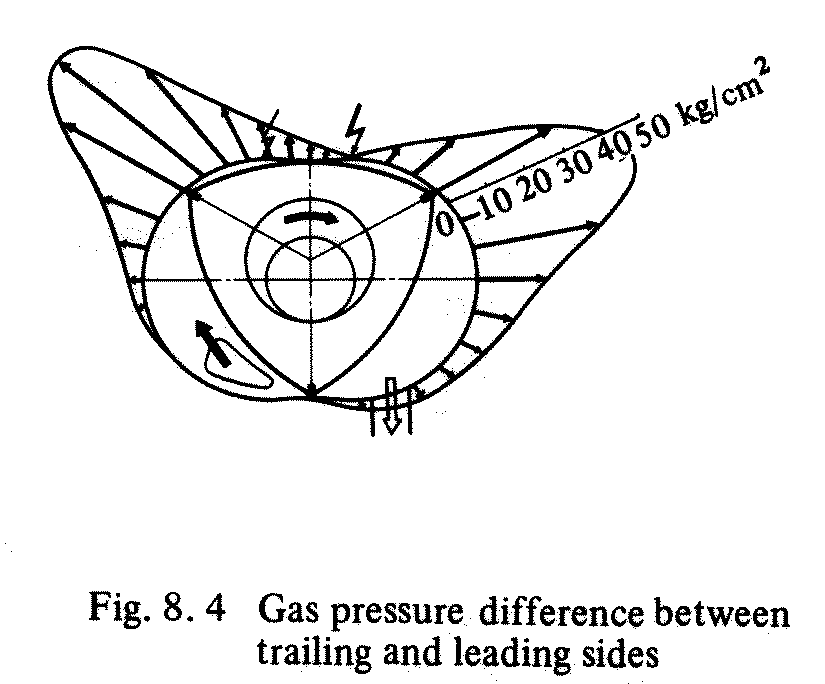
It is very important that the apex seal slots be ground properly. The surface
finish is very important, as is the true position of the slot. The gas
pressure that presses the seal against the slot wall is high, thus the normal
force against the slot wall is high (P*A). If the slot is rough, the friction
force tending to "lock" the seal to the rotor will be high. This can lead to
the "spit back" phenomenon that Mazda reported. When the engine is at
operating temperature, the rotor housing is no longer a true trochoid shape.
Pressure also deflects the housing a bit. Also, the rotor has some freedom to
move through the gear backlash and the bearing clearances. The apex seal must
therefore be able to move rapidly relative to the rotor to maintain sealing
against the trochoid surface. That is why low slot friction is important.

Regarding the pressure acting under the seal to force it outwards, yes that
is exactly why they work. The underseal pressure probably does not change in
lockstep with either the leading or trailing chamber pressure, as the gas
must get through the tight orifice that the seal clearance presents in order
to fill or empty the underseal volume. Thus, the underseal pressure might be
some pressure that is the average of the full cycle chamber pressure, with a
superimposed ripple of some unknown magnitude. This whole topic was the
subject of much research at Deere and Company. There was much analysis and
experimentation, but actually measuring any of these things in a running
engine is exceedingly difficult.

Jon Lauter
Rotary Power Marine Corporation
The chart is from "Rotary Engine" by Kenichi Yamamoto.
Unfortunately the diagram is rotated 90 degrees CCW compared to the
production engine.

Paul Lamar

The AirCraft Rotary Engine NewsLetter.              Powered by Linux.

http://home.earthlink.net/~rotaryeng/            http://www.linux.org