Paul wrote:
This is extremely interesting to me as the Moller Skycar should be the next
mode of transport for the more wealthy among us.
[snip]
Some people poo poo the idea but it is entirely within the laws of physics
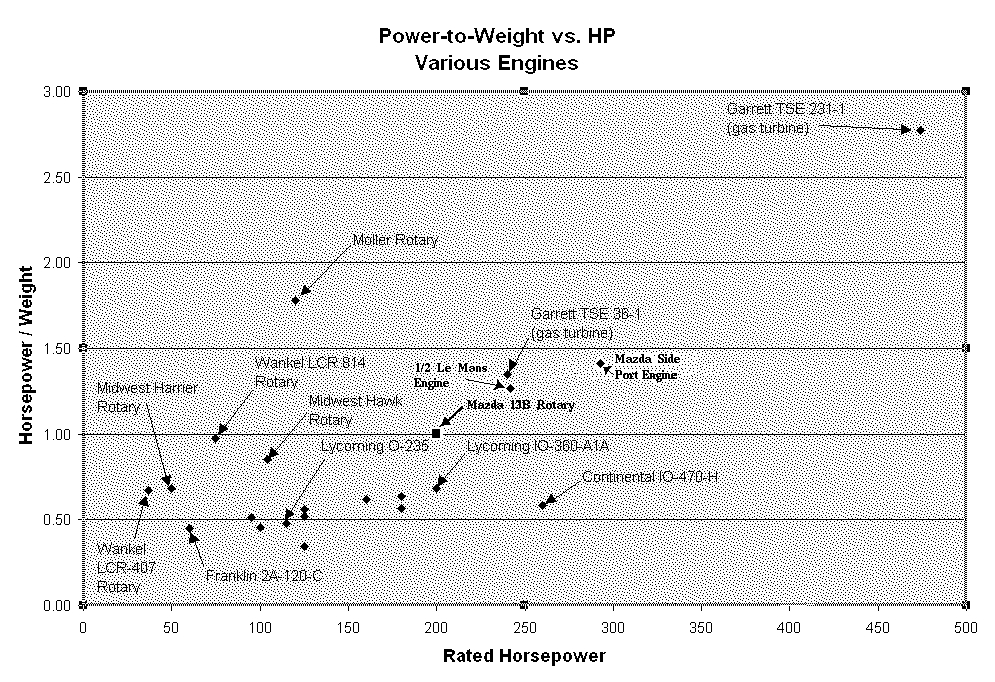
given the very high power to weight ratio of the Moller rotary engine.
See the chart below.
I'm more skeptical. Your own chart shows the Moller engine at something
50% better power-to-weight ratio than a turbine or a purpose-built race
engine. That sort of improvement calls for a technology leap which just
doesn't seem to be there.
BTW I think the development of the rocket powered ballistic parachute capable of letting
the entire aircraft down has added to to the Moller Skycar practicality.
Whilst a BRS would be a big plus for a Moller type vehicle, its
something I'm also skeptical about for regular GA aircraft.

Frank.
For one thing the small helicopter turbine shown has a gear box and the Moller
rotary does not.

Trust me Frank its there or nearly there! Perhaps a tiny bit optimistic.
Our own Jeff Spitzer on here was the engineer on the Moller engine.  When
you make the rotors smaller the RPM can go up so you get more HP per cubic
inch of displacement or per pound of weight. m*V^2/r That is why a tiny model
aircraft engine can develop a horse and a half at 20,000 RPM. That is also
why piston engines sometimes go to 12 smaller cylinders. The Moller is a
smaller two rotor. The Midwest and Wankel GmbH limit the RPM of their small
two rotor engines to about 6000 RPM for some strange reason.

The RPM limit of a rotary is controlled by rotor weight.
Also an aluminum rotor with steel or other anti wear insert for
the apex seal slot has not yet been tried to my knowledge.
Nobody is running both peripheral and side intakes and
exhaust ports yet which should help the breathing at say 20,000 RPM.
If you don't mind the cost ceramic apex seals with half the density of
steel or cast iron work fine.

Even if the power to weight ratio is only as good as a turbine the rotary
is one tenth the cost.

Sirus is selling the heck out of their four place C172 competitor with BRS.
We shall see the first time one crashes. BRS makers claim many lives saved so far.

Paul Lamar
I plotted the new side exhaust port rotary on the chart based on the
original HP numbers of 290 HP. Since then Mazda has come down on the
red line and the power to 250. What is remarkable  is this is a street
car engine.

BTW the BSFC of the side port rotary is probably now well under .5 while that
of the small gas turbine is .65.

Also BTW the plot shown for the 1/2 Le Mans engine is at 6000 RPM and not
at its rated 9000 RPM. I did that to illustrate the potential of peripheral
ports at 6000 RPM. The power to weight ratio based on 345 HP at 9000 RPM and
198 pounds would then be 1.72 or very near the Moller engine's power to weight ratio.
The actual four rotor normally aspirated Le Mans engine had 690 HP and weighed
396 pounds. At the end of the 24 hours the engine was hardly worn.

We have not yet discussed the HP potential of the turbo charged rotary.
Drag racers are currently getting as much as 900 HP out of a 260 pound turbo two
rotor. Admittedly on alcohol and nitrous oxide.

Paul Lamar

The AirCraft Rotary Engine NewsLetter.              Powered by Linux.

http://home.earthlink.net/~rotaryeng/            http://www.linux.org