Russell Kent wrote:
Paul wrote:
Vance, there is no reciprocating motion in a Wankel engine. Nada, zip, zero, none!
EVERYTHING moves in a circle. The connecting rods in a WW I rotary rock back and fourth.
Oh REALLY?  So precisely what circle do the apex seals move in (relative to their containing slot)?  And the oil
metering pump: doesn't it have a linear piston?  And the throttle linkage?  And the thermostat?

Neener-neener... ;-)

Russell Kent
The apex seals are the only exception and they move less than  several thousands of an inch.
What oil injection pump? My aircraft rotary has no stinking oil injection pump.
The throttle linkage does not move when the engine is running at a constant speed.

I think I was wrong about the WW I rotary connecting rods but they did have
reciprocating intake and exhaust valves as well as push rods and lifters.

I think what has Vance confused is the rotor motion. The subtle distinction is if the
CG of the part (rotor) moves in a circle it does not reciprocate. Just because
the rotor housing is a trochoid shape does not mean the parts that move inside
it.... reciprocate up and down.

Paul Lamar
Just run your rotary without those counter weights on the  eccentric, and then tell me there is no reciprocating
motiom. Just because it is turning while it is being displaced by the eccentric does not mean that it is not
reciprocating. Trace the path of the face of the rotor and you will see a definate sinasoudale path just like the
time displayed position of the piston in a conventional piston engine, unlike the almost perfect circle of the piston path in a WWI rotary. The beauty of the Wankel is that it can be perfectly balanced  since it does not have those swinging rods- This perfect balance can also be obtained in a "boxer" motor if you apply Scotch yoke construction to the crank- Vance
Those counter weight are to remove the external couple from a two rotor engine.
Certain configurations of a four rotor engine do not require them at all.
The engine is in total balance without the counter weights.

I think you are missing something Vance. Consider this. The maximum lateral
width in a horizontal plane of the rotor changes as it rotates about the eccentric
center and the e-shaft center line in synchronization with its path around
the inside of the trochoid.

This is the source of much confusion because at first glance it looks like
the rotor is moving up and down (reciprocating) inside the trochoid shaped
rotor housing. This is definitely not the case.

It is orbiting the e-shaft center line and rotating about its own center
at the same time. The CG of the rotor does not reciprocate in any way
shape or form. Nothing starts and stops as does a part in true
reciprocating motion such as a piston in a non rotary piston engine.

As far as the dynamics are concerned what happens to the CG of a part is all that
really matters. Any inertial loads on a given particle of a part ("the face of the
rotor"), due to strange paths through space, are handled by stresses internal
to that part. However this does not fit the definition of reciprocating motion.

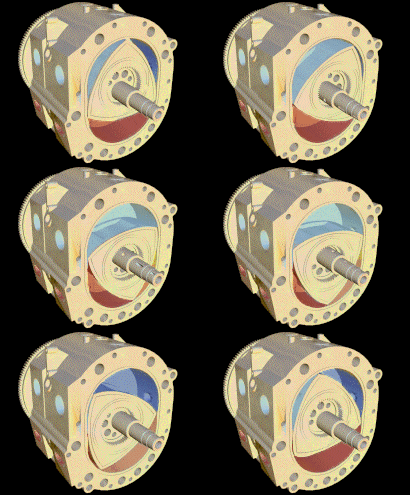
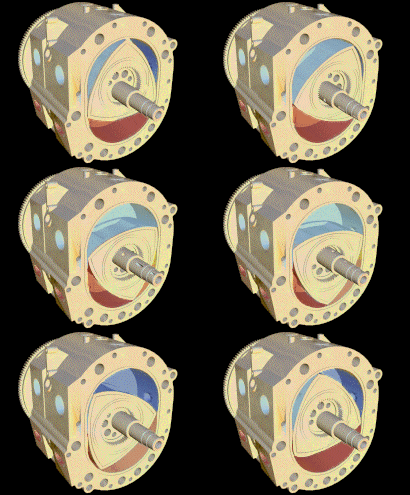
BTW Does anybody know how to slow this animation?

Paul Lamar

The AirCraft Rotary Engine NewsLetter.              Powered by Linux.

http://home.earthlink.net/~rotaryeng/            http://www.linux.org