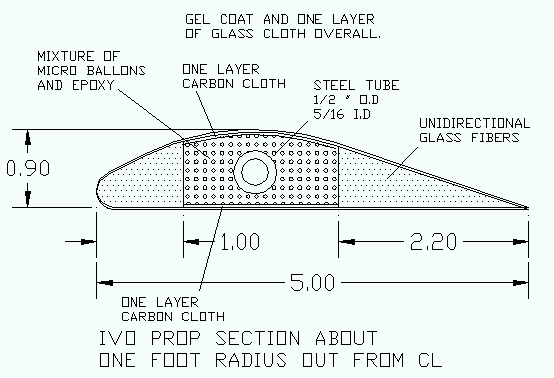
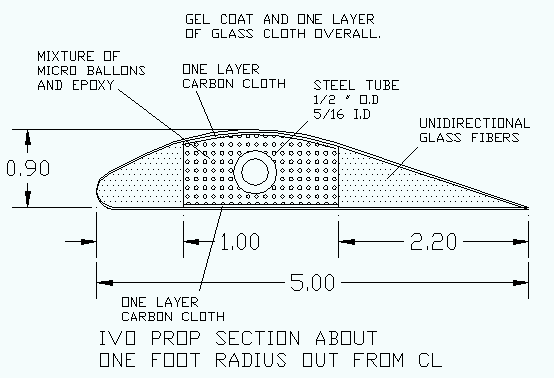
"I would hardly call it inflight adjustable. Yes the twist changes in flight.
It also runs into a brick wall at 180 MPH. If your 13B powered airplane is
slower
than that go for it. Dave Atkins has been cruising around with one at less
than
180 MPH in his RV6 for years. He made a low pass over Tracy's house with the
engine screaming but the airplane looked real slow for the sound coming out
of the prop and engine. Tracy's RV4 airplane with a wood prop looks much much
faster in a low pass.  Just an impression. "
Hello Group,
I need to buy a prop in the next several months and have been thinking
seriously about the IVO Magnum Deep Pitch Prop, but if using one is
effectively like putting a governor on me top end cruise, I will seriously
have to reconsider.  Does anyone know how to get in contact with IVO
directly?  Why don't we invite them into this conversation to explain why
they have never changed this problem?  I really don't understand why they
would continue to make the prop with the same known problem.  I know they made
a change to fix the hub / blade interface by knurling to increase contact
friction, but why haven't they extended the airfoil shape to the portion of
the blades nearest the hub?  Can anyone speculate on why they would continue
to make the prop this same way if it limits the top end?  Has anyone
discussed it with IVO Props directly.  If they would add the knurling, why
wouldn't they change the blades too?
Thanks,
Don
I have given this subject a lot of thought over the past five years or so.

Well the whole idea of the prop is to attach the low cost blades to the low cost hub
in a low cost manner. i.e. two bolts. This dictates the flat part of the blade near
the hub. No choice in the matter. Also IVO's props can be two blade or three blade.
The largest market by far is the ultra light market where the typical airplane
takes off cruises and stalls all within about 50 MPH. The ultra light engines and
PSRU's used do not have facilities for a conventional constant speed hydraulic prop.
Therefore there is perceived market for a low cost variable pitch prop in this market
but not really. A variable pitch prop in this speed range makes little difference
and nobody is selling a low cost real variable pitch prop for comparison purposes.

On the other hand there is little incentive for IVO to redesign the prop for the
very small 200 MPH auto engine powered airplane market were a conventional constant
speed prop cannot be used. Those people, flying aircraft engined airplanes that want or
need the short takeoff distance and cruise efficiency of a constant speed prop, use
the relatively low cost certified hydraulic versions for the most part.

There is a market in this range for a lighter weight prop and that is the niche Hoffman
and MT are in with their so-called composite variable pitch props. (They use 99% pure
wood blades but nobody can tell that by merely looking at them.) IVO could get in this
market niche if he wished but the returns would be small given the huge R&D and
certification expenses. That is one of the reasons the Hoffman and MT props
are so expensive. Besides that there is a hidden european government subsidy for Hoffman
and MT because of the noise regulations in Europe that encourage a special design three
or four blade prop. Most american props would not cut it in this excessively regulated
environment.

Paul Lamar
My 2 cents worth on the subject - I have not seen the so called high twist version of the
Ivo prop
but the flat 2 bolt mounting does not preclude having  a steeper angle near the hub. This is
no
different than the flat area on either awodd or metal fixed pitch prop, so he could set this
area
at a good compromise angle if he invested in the tooling to do so. My main concern withe the

Ivo is in making making it torsionally flexible enough to be twisted with that small rod, it

now concerns me about flutter. The 2 bolt mounting also worries me, and even he advises
against the use on engines with high pulsing loads such as the big fours.. A contollable
prop
is relatively easy to design, and not that hard to fabricate - but sphincter tightening bear
to prove.
I am building a 3 blade variable system, but intend it for use as a sort of ground based
air dynomometer for a long time before even considering fitting it with flight worthy
blades.
Vance
The AirCraft Rotary Engine NewsLetter.              Powered by Linux.

http://home.earthlink.net/~rotaryeng/            http://www.linux.org