Ed Anderson wrote:
   Hi Paul and Gang,

As Finn Lassen mentioned in his post about our joint visit with Tracy Crook
(which was Great, by the way), I ran into oil pressure problems prior to
departure from Tracy's.  If you are rebuilding your own engine please read.

I won't go into the even longer winded report about what we went through to
eliminate all potential causes before tearing down the engine, but it was
thorough.  The symptom was oil pressure at 20 psi at any rpm above 3000 rpm.
I noticed it while taxing to the down wind end of the runway and aborted my
planned take off.  Bruce also assisted over the phone by providing a list of
possible causes which we eliminated one by one, starting with pressure
sender and gauge.

Because many are overhauling their own engines, I believe the cause of the
low oil pressure is significant.  Basically, we have discovered it is fairly
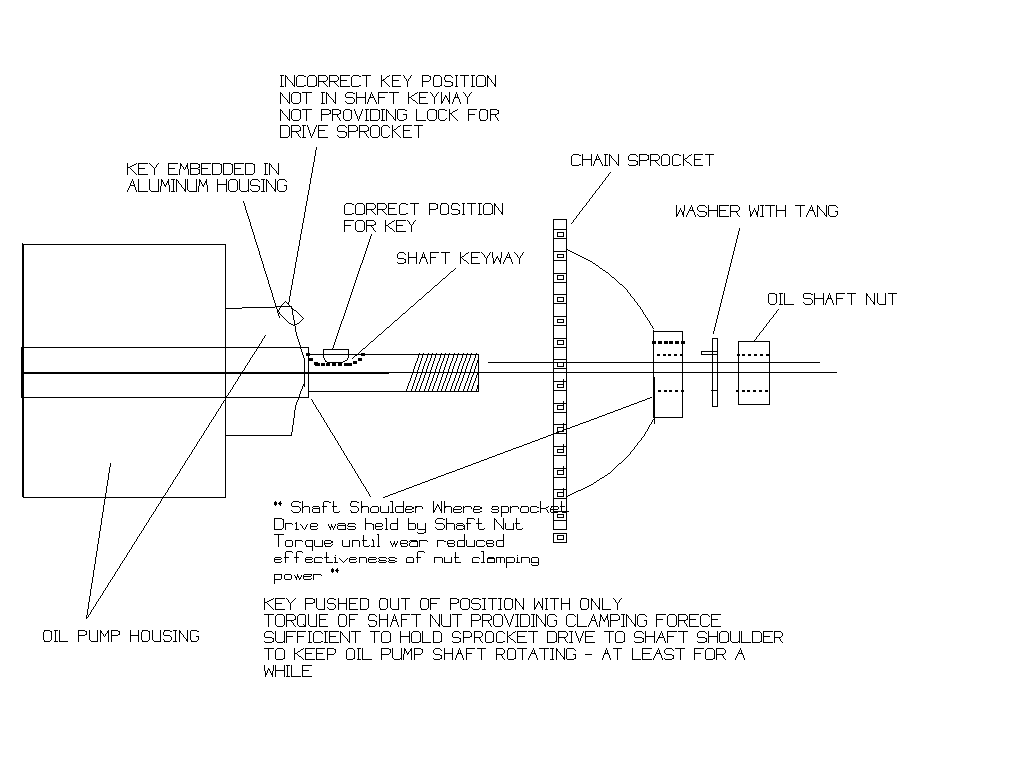
easy to assembly the oil pump with woodruff key, drive sprocket, washer and
nut and NOT HAVE THE KEY in the keyway.  It is possible to push the key out
of the keyway when sliding on the drive sprocket and to trap the key between
the drive sprocket and pump housing (mark of the key having  been embedded
in the pump aluminum shaft boss were clearly evident).  Furthermore, there
is plenty of shaft threads left sticking past the torqued nut to not raise
any notice.

Having talked to Bruce Turrentine and Leon Promet (who was kind enough to
point out some inaccuracies in my original sketch and
conclusion about the likely scenario of the end results), this occurrence is
not as rare as you may think.  Fortunately, once aware that it can happen,
it is easy to prevent.

  It now appears that I have flown the aircraft for approx 10 hours with only
the clamping pressure of the shaft nut holding the sprocket to a shoulder of
the drive shaft (I know - scary) and the woodruff key apparently embedded in
the soft aluminum shoulder of the oil pump (it finally worked its way out
and I found it in the bottom of the oil pan).  Only, the fact, that I forgot
to close my throttle during start up (won't bore you with that story but it
was related to taking exhaust noise level readings)  and having the engine
suddenly race to 5000 rpm (with cool 50 weight oil) broke the clamping
pressure and cause the sprocket to start to spin on the shaft..

 I have attached a sketch of the oil pump assembly that shows what  I am
talking about

  1.  The attached sketch of the oil pump assembly shows the shaft shoulder
against which the torque of the shaft
nut kelp the drive sprocket clamped.  This clamping force was adequate for a
while to enable the sprocket to turn the pump against the oil pressure.

2.  The quick runup to 5000 rpm with a cool  50 weight oil  caused
sufficient back pressure against the chain sprocket to break it loose from
the nut's clamping force and start to wear.  The sprocket drive did have a
1/64" deep groove worn on the inside of the sprocket around the sprockets
shaft hole   There remained sufficient friction to give 20 psi oil pressure
while I taxied, but that would have certainly decreased as the sprocket
would have continued to wear against the shaft shoulder. Any bets about
whether I would have made it around the pattern?

3.  The keyway (woodruff) slot does not extend to the end of the shaft so it
is difficult to see the key when the sprocket is fully seated (and then only
if you look for it)

.  Leon pointed out that the use of a paper clip
with one end bent out at 90 deg can help asset whether the key is properly
in the keyway. Insert the bent leg of the paper clip into the keyway,  if
the bent leg goes all the way into the slot, the key is not in the keyway
And as I have shown, you can fly without the keyway) ....at least for a
while.  (Thinking about the time spent over the Okefenokee swamp, I am sure
glad I torqued that nut to 30 ft/lb)

4.  Tracy and I tried assembling the key in the keyway and sliding the
sprocket on the pump shaft a number of times and it is surprisingly easy to
push the key out of the keyway.  As long as it drops out the back side and
gets your attention, you are OK.  However, it is possible to push the key
out of the keyway, clamp it between the sprocket and pump housing and never
notice it is no longer in the keyway unless you specifically check.

Over the years I have had a number of hassles getting sprockets, gears,
pulleys over obstinate keys/keyways, but never had one where it was possible
to push the key out of the key way and not know it.

 5.  The most important point is that it is possible to get this all
important assembly step incorrect and careful attention should be given
this step!

6.  However, all of this could not have happened at a better place than
Tracy Crook and Laura' IRAN (Inspect and Repair As Necessary) facility.
Hospitality was superb and being able to talk into the wee hours of the
night with someone about rotaries and aircraft was GREAT!

Best Regards

Ed Anderson
It is always great when somebody makes a mistake like this and lives to tell
about it :-) We all learn. Thanks Ed for sharing this.

BTW perhaps something like this happened to Andy Venable'ss engine when he
lost oil pressure.

Paul Lamar

The AirCraft Rotary Engine NewsLetter.              Powered by Linux.

http://home.earthlink.net/~rotaryeng/            http://www.linux.org