I'm kind of in the same boat. I'm trying to fit my manifold into the
space of an RV-4 cowl without any bumps or protrusions. ( this is a non-
standard cowl without the cowl cheeks) The oil filler neck and dipstick
occupy some valuable real estate there. I'm toying with several ideas.
One is to put the resonation chamber and throttle body on top of the
engine. It's tight, but I have about 5" between there and the engine
cowl. I should give me 18" intake runners.
The other scheme is to cut off the oil filler projection on the spark
plug side of the engine and weld on a plate. Have a remote oil filler and
put a sight glass for oil level(I'd scavenge one off a japanese
motorcycle). The throttle body would go down the spark plug side of the
engine in between the sets of spark plugs.
I've got a question though- does it matter if I put the inlet from the
throttle body on the outside radius of the resonation chamber? Would that
screw up the shock waves traveling back and forth between the two rotors?
Brian Trubee
Redmond, Wa
Brian,

  I know the problem. I removed the filler and dipstick tube. I'm building
an aluminum oilpan with a relocated sump. I thought I needed this to get a
better inlet duct into the radiator. I'll put a new filler/dipstick into
the pan.

  There was some discussion on the other list about a year ago regarding
position of the TB on the dynamic chamber. There was no actual test data
presented to back up one theory as opposed to the other. Paul Yaw felt that
whatever advantage there may be in placing the TB on top of the dynamic
chamber rather than on the outer radius would be more than offset by the
better flow that an outer radius position should provide. His position was
that the top mount position that Tracy uses is terrible from a flow
standpoint because the air is forced to make a sharp 90 degree turn into
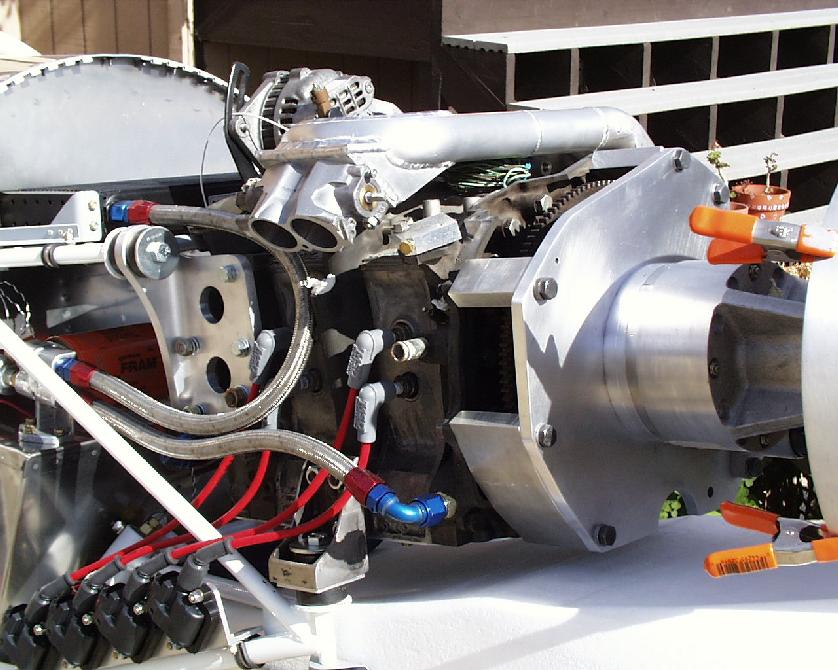
the runners. Both arguments appear to have merit so I took the compromise
position which also turns out to be the best fit within a cheekless RV4
cowl. Here's a picture. It hasnt run yet so I cant tell you how it will
perform. But I'll let you know.

Mike Wills
The AirCraft Rotary Engine NewsLetter.              Powered by Linux.

http://home.earthlink.net/~rotaryeng/            http://www.linux.org