Barnhart wrote:

By going with a larger turbo would it be easier to cool with oil by having more area and the same amount of heat?  Any idea if they would sound different?  Reliability? Is there a particular type of intake porting that seems to work well with the turbo? How long do they last?  Obviously you would have to keep the drain for the oil, and heat shielding in mind also.

Thinking about a turbonetics set up.  Iconel wheel, 5pounds min. boost, and a manual boost to no more than 10lbs. All I want is to be able to keep 300 hp  on a 20b. Any wild guess as to how many rpms to get 300 hp?

From the  homework  I did  into turbos, seems like the rotary is in its own little world....

Not looking for alot of boost, just enough to keep some power on those higher airports.

Barny
The porting on the 20B is already set for turbo's as all 20B had
dual turbo's.

I think yes on the larger turbo but then you have the weight...

Turbo RPM? I have no idea. 20B RPM's?  6000 and 5 psi ought to do it.

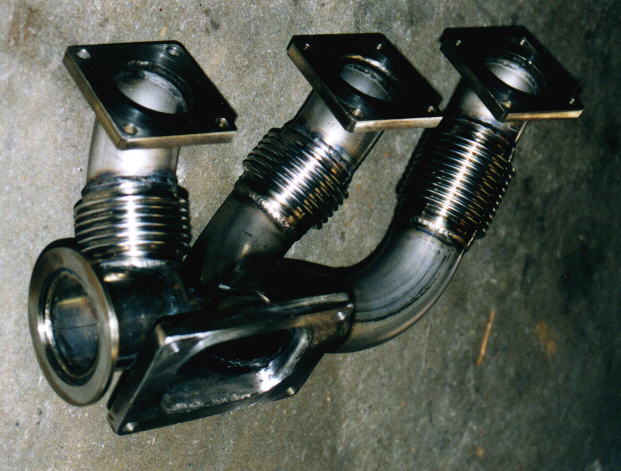
My issue is cost and time. Making a manifold that will not crack could be
a long trial an error process. Jim Mederer spent $3000 on this Inconel manifold alone.

Water cooled turbo bearings are a good idea. You can get them as options on
the TO4 and TO3 I think. Air-cooled aircraft engines don't have that luxury
option.

The stock 13B 89-91 turbo also has a built in waste gate unlike most Garret
turbo's that saves weight and cost besides being water cooled.

If the stock 89-91 Mazda turbo works it will be a real bargain in turbo aircraft
engines. Good power to weight ratio too as the turbo only adds about 25 pounds.
You save the weight of the muffler and long exhaust pipes.

Paul Lamar

The AirCraft Rotary Engine NewsLetter.              Powered by Linux.

http://home.earthlink.net/~rotaryeng/            http://www.linux.org