The prop program by Dokus and Dubner shows a 2.2% loss of efficeincy
between a 76.4" prop (at 2700 RPM) and a 64" prop (at 3225 RPM).
This would indicate that there is not much difference between the 2.17
ratio and the 2.85 ratio.  These numbers are for a tip speed of 900 ft
per second.  900 ft per second is 80% of Mach at sea level on a 'normal'
day (1114.4 fps).  This also explains why the canard guys go so fast
with small diameter props.

Ken Powell
I'll let Bill explain the chord factor because I  don't understand it yet.
I think this is for a 16 series.

The second chart is lift to drag ratios at Mach .78 for different airfoil
sections.

Paul Lamar
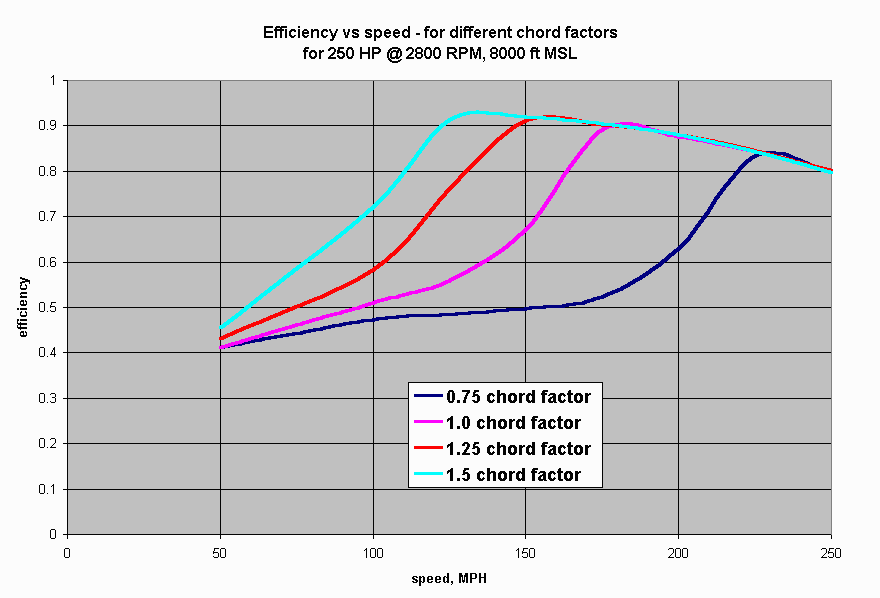
Yes, Bill, Please explain the Chord Factor.  What ever it is, clearly 1.5
looks better than 0.75.  If it implies some width to length ratio, I am
interested as I have a narrow chord prop - am I losing efficiency due to
this??

Ed Anderson
I am using a chord factor to scale the blade width up and down to observe
the effects of narrow chord vs wide chord blades.  What the graph is showing
is that when the chord is too narrow for the rated HP you increase the blade
angle until you absorb the HP (constant speed operation), but a bunch of the
inner blade is stalled to get the HP absorbed - i.e. NOT making thrust very
efficiently.  As the chord factor increases (a simple multiplier on the blade
chord selected as a baseline) you finally reach enough blade area to absorb
the design HP at the design RPM with little or no stalled portion of the blade.
This is one of the things that I learned from running literally a couple of
hundred
different design sets thru my sim program.  Notice that at high speeds, as you
unstall the blades, the different chord blades all come up to the common curve.
So, the paddle blades are really for TO and climb conditions.

Bill
The AirCraft Rotary Engine NewsLetter.              Powered by Linux.

http://home.earthlink.net/~rotaryeng/            http://www.linux.org