Russell Kent wrote:
Paul,
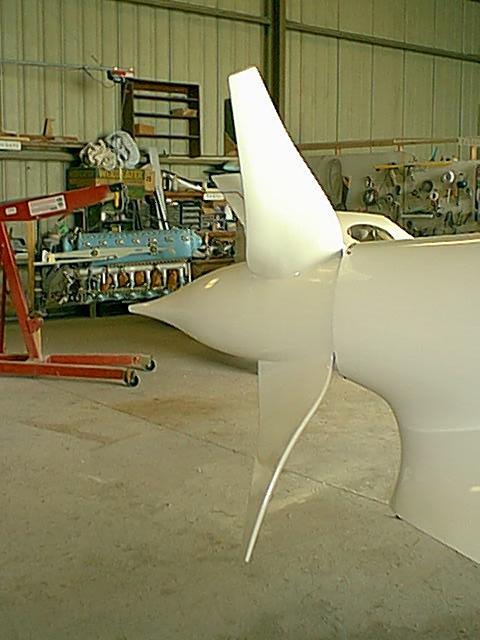
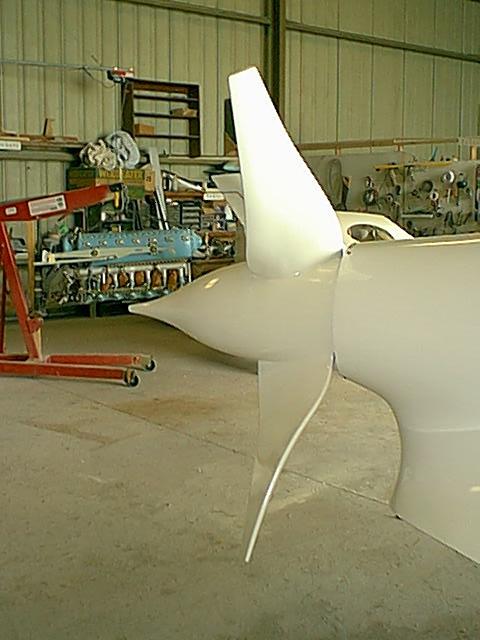
Attached is a photo of the prop on WingCo's Atlantica mock-up.
Supposedly it is 48" and "has flown on a Cozy with a 220 hp
Franklin" (according to Alan Shaw's message).  Alan is musing about
a 52" version of the prop to match with the a 285HP @ 3500 RPM
engine.

Any comments?

Russell Kent
I had a long talk with the principle on this project at S&F. Anybody undertaking a project
like this should study as much of aviation engineering history as possible.
He had read a book on Horton flying wings but the messages did not seem to sink in.
For an example many people have tried these types of props in the past besides Horton
(the Carter Coptor comes to mind) with mediocre results and if you study prop theory
and experimental data on props you can see why. The root blade area does little around
the hub.

The serious problem with pushers is you need long landing gear to keep
the tail high enough so you can use a long and efficient prop. Obviously this
prop is an attempt to bypass that problem. It won't work. Long props are almost
a law of physics.

That is just one example of the many problems with this design. He did not seem to
realize that you cannot count all the planform area of a flying wing as lifting
surface. Some of the outer wing surface must provide downforce to maintain
pitch stability. This extra area adds to the skin friction making flying wings
not significantly less drag overall than conventional designs.

The other very serious problem is landing speed as it is nearly
impossible to provide enough pitch authority in a flying wing to compensate
for a severe aft shift in the center of lift when flaps are deployed. A third
problem is the V shaped notches in the trailing edge that will generate huge
drag producing and power robbing vortices. Any time you have a significant
pressure difference between top and bottom on a oblique trailing surface you
will generate a vortex. The energy in this vortex will ultimately come from
the fuel burned.

This is not an opinion. It is a law of physics.

There is a very good reason why most airplanes all look the same. 100 years
of physics and trial and error. This is not to say configuration
improvements are impossible but the probability is low. Strange airplanes
are usually tailored to specific missions with serious compromises in
other areas of performance.

Paul Lamar

The AirCraft Rotary Engine NewsLetter.              Powered by Linux.

http://home.earthlink.net/~rotaryeng/            http://www.linux.org