Neal Scherm wrote:

What BTU capacity should a heat exchanger have to cool a turbo 13b? I
was looking at Fluidyne's parrallel unit @ 65,000. They also make a
80,000 unit but it's huge. Seems like it would make a great cooler for
the pusher type or a remote location install (i.e. c/g correction for a
heavy motor).
Any comments?
Neal
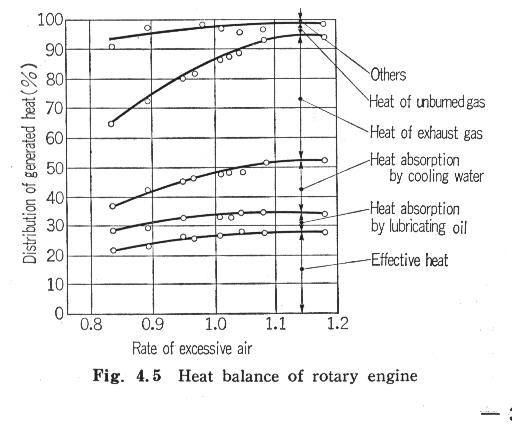
Here is the heat balance for a rotary. One HP per hour is 2545 BTU/hour
Effective heat is HP out of the shaft so about the same HP goes
out the cooling system. If the engine is putting out 200 HP the
same HP is going out the cooling system. Typical more or
less plus or minus a few percent one way or the other for
all intermittent combustion engines. About one third goes to the
oil unlike most piston engines.

Paul Lamar
Mike Wills wrote:
Paul,

  I couldnt open that attachment. Anyone else have that problem?

  Where did you get the 2545 BTU/hr figure? Since I cant open the
attachment I'm not sure what this number means. Are you saying this is the
total energy released per hour or is this the fraction of energy that comes
out as shaft power?

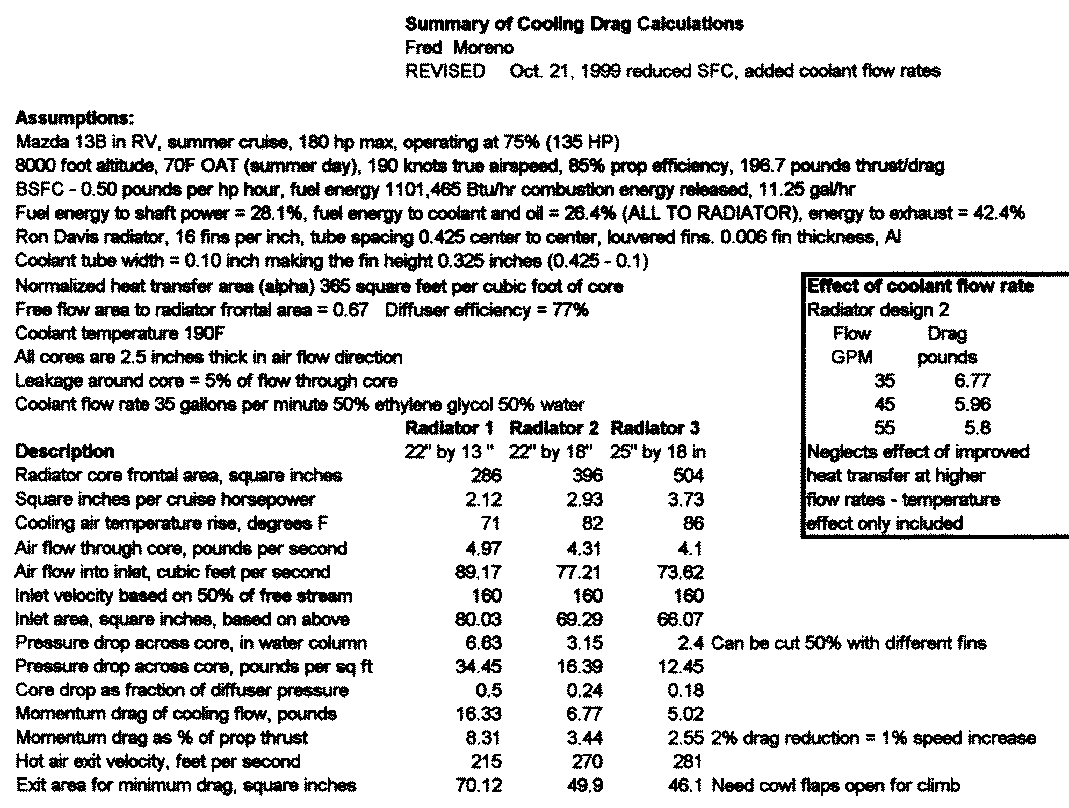
  On the cooling analysis that Fred Moreno did for my application he came
up with  assuming 180Hp and .5 BSFC for total energy
released. His analysis went on to indicate that 28.1% of that went into
shaft power, 26.4% to coolant system and 42.4% out the exhaust. With 1/3 of
the cooling going into oil that means a cooler of about 95000 BTU/hr. The
large Fluidyne cooler that Neal mentioned was the largest I was able to
locate so I abandoned the idea of a oil/water exchanger.

  This info was all in the one page analysis that you recently reposted for
Ken Powell.

Mike Wills
Standard conversion from HP to BTU's. Here is a double check.
Kilowatts to BTU's/second  multiply by 9.48 X 10 ^-1. One HP equals
.746 Kilowatt

1,101,465 BTU/hr sounds about right for the total fuel energy.
I think you are misinterpreting that to be the heat exchanger
capacity required.

Here is the heat balance chart again and the one page analysis.


Paul Lamar

The AirCraft Rotary Engine NewsLetter.              Powered by Linux.

http://home.earthlink.net/~rotaryeng/            http://www.linux.org