The rotor housing were not shrunk. Measured them in several
places and it all came out to 3.148 3.149 which is right at 80 mm.

There was some oil coking on the chrome surface but that could have happened
in the 120,000 mile life as a car engine. IMHO that would not happen with
two cycle oil as it burns cleanly. There are several theories on this
phenomena. Everitt Hatch and Jim Mederer thought it consisted of burned
burned oil and tried to cool the housing better in this area. I think the apex seal
pressure is less as this occurs right after the seal jumps over the
hump. It does not appear to hurt the power or the fuel consumption,
Perhaps on the contrary as it might build up the surface of the housing
to more closely conform to what is needed to minimize the in and out
motion of the apex seal. If you follow my drift. I think think it is mainly
a cosmetic issue.

I would not hesitate to put these rotor housing back in the engine with
new tension bolts and O-ring and run it for another 1000 hours.
I would not even use new apex seals as the edges of the housing
conform to the present corner apex seals.

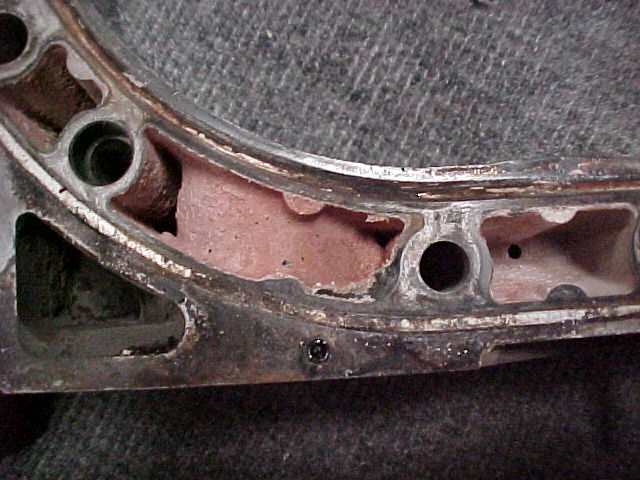
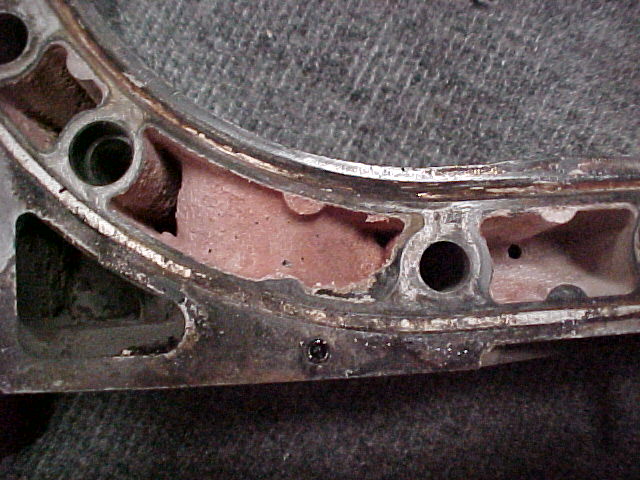
There was an O-ring failure down in the region of the broken tension
bolt. As you can see in the picture the bright line is the area
where the inner O-ring was still sealed and the black area is where it was
leaking hot combustion gases into the water jacket. This was typical for all
four inner O-rings in this area.


Paul Lamar

The AirCraft Rotary Engine NewsLetter.              Powered by Linux.

http://home.earthlink.net/~rotaryeng/            http://www.linux.org