"Bass, Jerry" wrote:
I have had a coolant problem since I got this engine back from Turintine.
It
would bubble out of the block as I came back from flying.

I added stop leak and have been flying since.

It did boil over on one 90 degree day, but I took the bonnet off and it
cooled right down.

I will send the block back to Bruce soon.
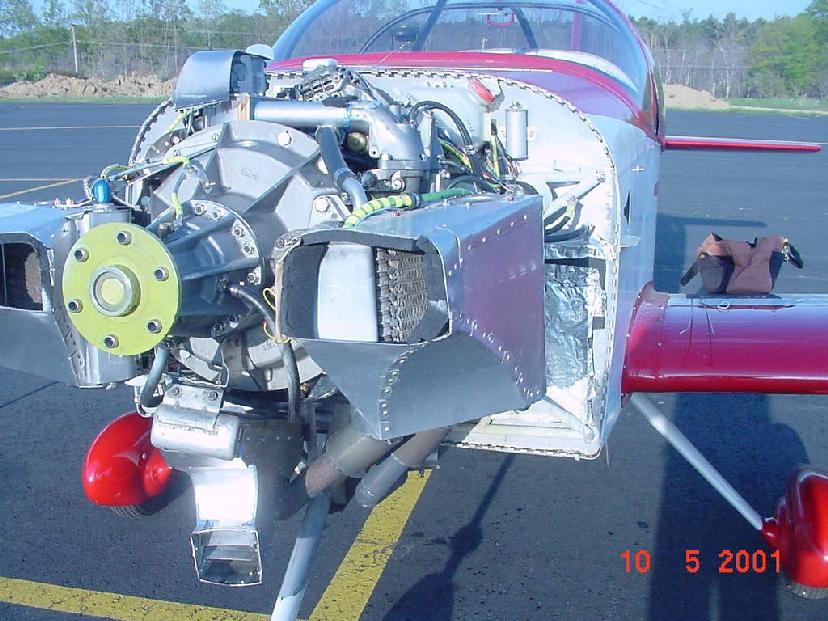
Looking at what I can see from these picture  I suspect you
have an aerodynamic and other problems with the cooling system.
It looks like the evap cores are in series which is not as good
as in parallel. Evap cores are not the best choice for rads.
Too thick and too hard to jam air through them at taxi and at
100 MPH climb speeds.

Also your air intakes are much smaller than Tracy's and he had
trouble cooling only 150 HP at first. I am sure you are generating
a lot more than 150 HP running your engine up to 7000 RPM
with your 2.85:1 psru ratio.

I can't see very well from the first flight picture if you have applied the
principles of Kuchemann & Weber to your intake duct walls as Tracy has
done but it does not appear to be the case. The walls of the ducts
should have this characteristic bell shape of this Me 109 duct
shown in the attached gif.

Also the catch can looks to be improperly plumbed. The overflow hose
needs to go to the bottom of the can so it can suck up the overflow
coolant once the engine has cooled off. Don't forget the rad
cap has two valves. One pressure relieve valve and a one way valve
for returning the coolant to a cooled off engine.

This overheating does not appear to be the fault of the 13B.

Paul Lamar
"Bass, Jerry" wrote:
Sending pix of inlet ducts.
Mazda has the oil cooler laying flat, on edge behind the radiator.  I may
move mine to R side cowl and put it on edge, rather than laying it flat like
you see.
Jerry Bass
The duct themselves look pretty good. The main problems are;
the exhaust is radiating heat to the oil cooler and the
turning vane dividers in the oil cooler duct are hurting and not helping.
Don't worry about turning the air flow. The function of the
duct is to slow the airflow and convert it to pressure.

Drill the rivets holding them in and remove them. They are cutting
the mass air flow to the oil rad.

Shield that exhaust pipe from the oil cooler duct sheet metal.
The principle is; if the rad can "see" the red hot exhaust pipe
lots of heat transfer is taking place by radiation.

What does your out let area look like?

I'll send the rest of the pictures later.

Paul Lamar

The AirCraft Rotary Engine NewsLetter.              Powered by Linux.

http://home.earthlink.net/~rotaryeng/            http://www.linux.org