Perry Mick wrote:
Paul:

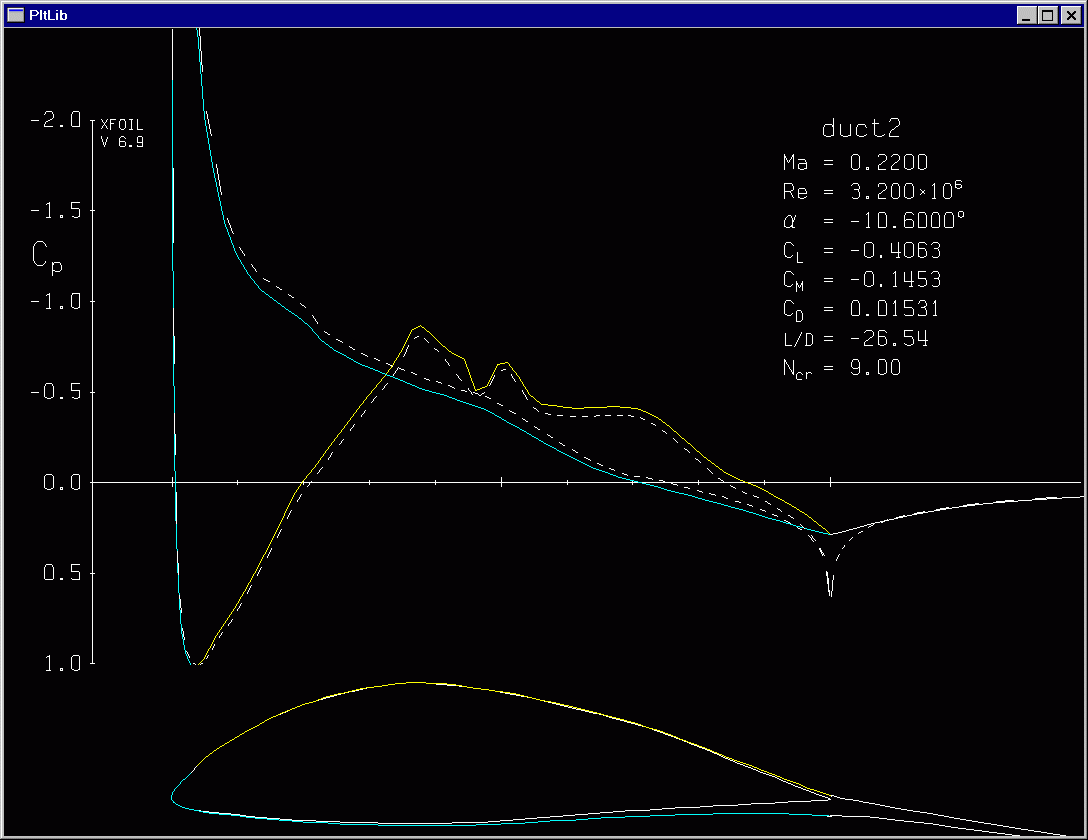
I've been learning to use xfoil.  I put in duct2 for fun.
Angle of attack is -10.6 degrees relative to chord line.
Mach .22 and Reynolds 3.2e6 correspond to about
150 knots, the speed inside the duct.  What do you
make of these numbers?  Cl is negative, indicating
lift is "outward", probably due to pressure on the
inlet.

Also, I noticed Bill took into account Mach effects
at the blade tips in the variable pitch prop design.
I can use xfoil to analyze each blade station airfoil
at local Mach and determine optimum twist at cruise
for my next fan.

--
Perry J. Mick
Duckt N7XR
http://www.ductedfan.com
Its hard to say as you are forcing the flow with the fan.
Without some sort of three D visualization of what the actual
airflow looks like inside the duct ...who knows. The modern super
computer 3D simulations used by P&W, GE and RR  are not talking too much
about this. There are some papers out there however.
Search the SAE and ASME. I think I recall some papers on this subject.

You also need to do a pressure survey on the back of the cowling to see what
effect this backward slope has on drag. With a new cowling your speed might go
up a lot more than one would expect because the fan could be attaching
and forcing the flow back there and increasing the low pressure and hence the
drag on the cowling in front of the fan.

I think that is one reason Charlie Airesman does so well with his direct drive
prop. He has a long extension shaft streamlining the high velocity air
in front of the prop minimizing any backward slope to the cowling in that
area.

As a bit of info for aerodynamic novices. The pressure vector is always
perpendicular to the surface. When this vector is resolved into its
horizontal and vertical components and integrated over the entire
skin surface of the airplane the total lift and drag are determined.
Any low pressure on a backward and inward sloping surface results in drag.

In order to get the lift and drag from these curves on the attached chart
one must take into consideration the angle the surfaces make with the
horizontal and resolve the pressure vectors into lift and drag components.

Paul Lamar

The AirCraft Rotary Engine NewsLetter.              Powered by Linux.

http://home.earthlink.net/~rotaryeng/            http://www.linux.org