SNIP
 I forgot to mention something else we also learned with Perry's cooling
 system. If you have a nose (pusher) or tail dragger you are unlikely to
fill
 the engine without trapping air unless you vent the rear (in the car) end
housing
 or raise the nose or tail until the engine becomes level or the
 water inlet to the block passage becomes higher than the rear end housing.
 The water inlet passage to the block is located right behind the water pump
 between the front end housing and the water pump.

 That is because the water inlet to the block is lower in tie down attitude
 so there could be a large air pocket in the top of the block. It is a good
 idea to put several strategically placed  vent valves  in
 the system and open them when filling the system. Vent lines from the
 rear end housing would also work.... connected back at the filler necks.
 The vent lines are a better idea because the rear end housing could trap
 vapor in a high angle climb attitude.

 Paul Lamar
Good information and tips Paul

Bill Schertz
KIS Cruiser #4045
Also while we are on this subject Perry's system cools very very well
both on the ground and in the air despite a very small radiator
(when it was not leaking). My theory
on this, and Perry holds the same opinion I think, is; the fan is very
effective in drawing air through the rad. For all you pusher guys out
there pay particular attention to your air outlet position. I think the
best configuration is two cowl flap outlets about half way out the radius of the
prop in the trailing edge of the wing/cowl just a few inches in front
of the prop. One of which should incorporate the exhaust pipe. This assumes a
NACA duct bottom fed pressurized cowl with the rad under the engine. Here is
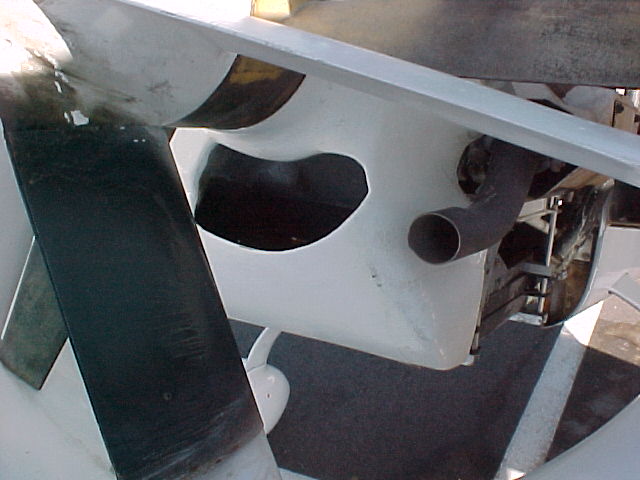
a picture of Perry's less than optimized radiator air out let. The next
iteration of Perry's cowl will include the exhaust pipe in one of the
openings I think. His prop/fan is turning twice as fast of course which is
also a big, on the ground, cooling advantage.

Paul Lamar

The AirCraft Rotary Engine NewsLetter.              Powered by Linux.
ACRE NL web site.
http://home.earthlink.net/~rotaryeng/            http://www.linux.org