Charlie and Tupper England wrote:
Lonnie,

Belleville or not, it's not a good idea to run a wood prop
without a crush plate between the bolt heads & the prop. The
crush plate spreads the pressure over the entire diameter of
the prop hub, instead of just 6 1" dia circles. No crush
plate is begging for a prop failure. You can still try the
bellevilles outside the crush plate.

That said, I will tell you that I live it the deep South
where humidity varies from 30% to 100% & temps from near 0
to well over 100 & I've never had a problem with prop bolts
loosening after proper installation.

FWIW,

Charlie
Absolutely correct about the crush plate.  Since they are aluminum
in all the cases that I have seen, I suggested hard steel washers to
keep the edge of the belleville washer from gouging into the aluminum.
I thought this was understood, but apparently not.  Thanks for the
clarification, we are about communication and if it is not clear to
everyone, we need to comment and clarify, like this.

As to the 30-100% humidity, I agree.   The issue is (apparently)
going from this (normal, in view) environment to a very low humidity
(desert) like 5% RH and apparently losing the preload.  I cannot
personally verify that humidity related shrinkage is the cause of
losing
the bolt tension, but I can absolutely verify that if the tension is
lost,
the bolts will break soon thereafter.  This humidity related prop loss
issue was dealt with extensively in the Canard Pusher (RAF newsletter)
in the 80s and later.  Dick Rutan had a propless IFR landing once for
this reason, more fun than I need.

Bill Freeman
Alfonso Lebron-Berges wrote:
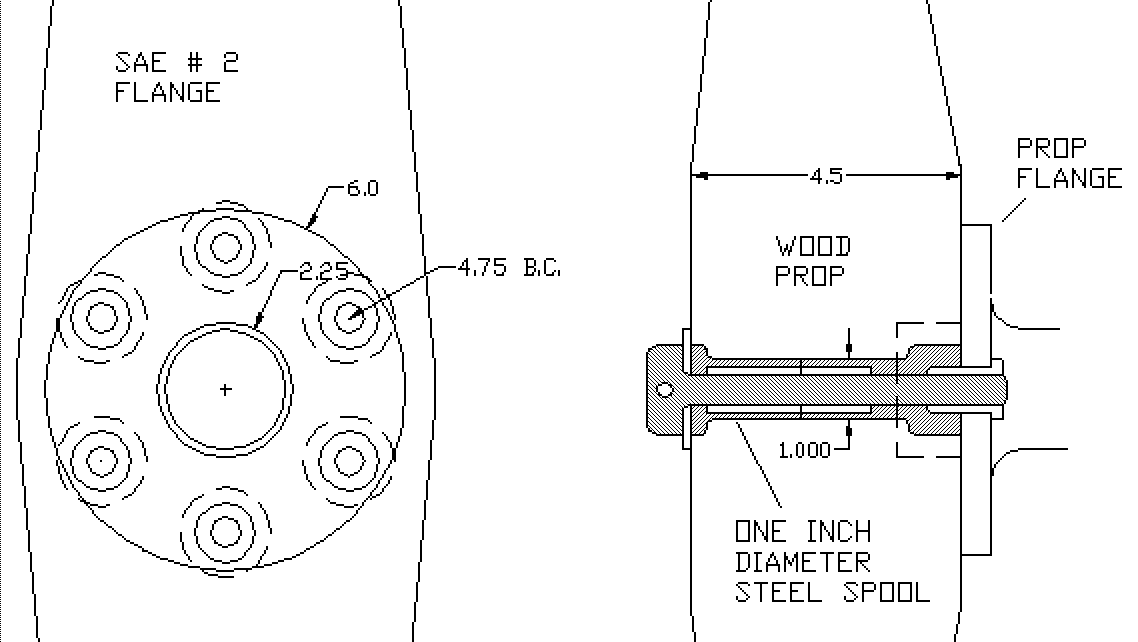
How about inserting a metal sleeve around each bolt. This should serve
to keep the tension constant irrespectively of the wood moisture
content. I think this is used quite often whenever a metal bolt goes
through wood or a softer material.

Correct me if I am wrong please.

Alfonso Lebron-Berges
In theory the torque is transmitted not by single shear on the bolts
or the metal sleeves as one would think but instead by friction between
the prop flange and the back of the prop. The bolts are merely there to keep
the two surfaces pressed together so the friction can work.

The force  transmitted between two surfaces is coef. of friction times the force
pressing them together. That is why a truck can stop about as well as
a car.

This is not to say your idea will not work. If carefully redesigned,
taking into consideration the allowable  bearing stress distribution of the
relatively large diameter sleeves in the wood, it could work well.
I had considered this at one time. See the sketch below.
The bolts then indeed could transmit the torque in single shear.
Alternatively the the torque could be transmitted to the sleeves
by friction and then transmitted to the wood by compression forces.

I think what happens is when you go through all the numbers it is
lighter in weight and lower in cost to not use metal sleeves and rely
only on the friction between wood and the prop flange.

Paul Lamar

The AirCraft Rotary Engine NewsLetter.              Powered by Linux.
ACRE NL web site.
http://home.earthlink.net/~rotaryeng/            http://www.linux.org