The only design I have that is practical for the do-it-your-selfer
is a
simple digital fuel flow indicator which is not suitable for
updating
with a
totaliazer function. Ed Anderson is flying one of these so maybe he
will
update us on how it is working. If there is any interest in this
simple
version I will post the schematic & parts list here.

Tracy Crook
tcrook@rotaryaviation.com
www.rotaryaviation.com
Ed Anderson wrote:
Yes, thanks to Tracy I now have a very simple (and fairly accurate) fuel
flow meter that cost approx $20-$40 in parts (depending what you have in
your parts bin).  Basically (correct me if I get this wrong, Tracy), it
measures the fuel injector duty cycle (higher duty cycle = more fuel
flow)
of the primary injectors. Its accuracy depends on how much effort and
time
you are will to take to calibrate it to your system. (I believe if you
have
a pulse generator, Tracy can tell you what parameters to set in the
generator and what read out you should get) OR you can fly at a set
rpm/altitude for a set period of time noting the fuel flow reading.
Measure
actual fuel used and adjust meter to match. Only need to calibrate for
one
flow (I recommend your cruise rpm) I find it very useful and it does
not
care whether you have a fuel return or not since it only measures fuel
injected (actually time injector is open/time between injection pluses).

I use it to  fine tune my take off power (fuel flow setting) with the
mixture control.  It is possible to set the mixture so rich that you are
actually losing power - not desirable on take off roll.  But, with the
meter
I can set the fuel flow against the rpm I see and be reasonably close to
the
Best Power Air/Fuel ratio.   In cruise,I can be flying along at economy
cruise and simply crank the mixture richer and watch the fuel flow meter
increase, AF meter show richer mixture and the EGT increase, feel the
engine
pull harder and watch the airspeed increase - almost makes you fell like
you
are in control {:>)

.  The fuel flow  meter together with the Air/Fuel indicator provides a
wealth of information about what your engine is really doing.  Much
better
than relying on the ole ear. Even if you don't calibrate it - it will
still
provide indications of relative fuel flow - you change something and the
meter indicates fuel flow increase or decrease, useful even then.

 For the $$, you can't beat it.  Only potential draw back (and I don't
consider it one), its reading of fuel flow is doubled when only primary
injectors are firing - i.e. before the secondaries stage.  But, since
that
happens before 3000 rpm its of little interest to me.

Once again, thanks to Tracy for a valuable but inexpensive little tool.
No
it does not have a totalizer function - but then it does not cost
several
hundred dollars

Ed Anderson
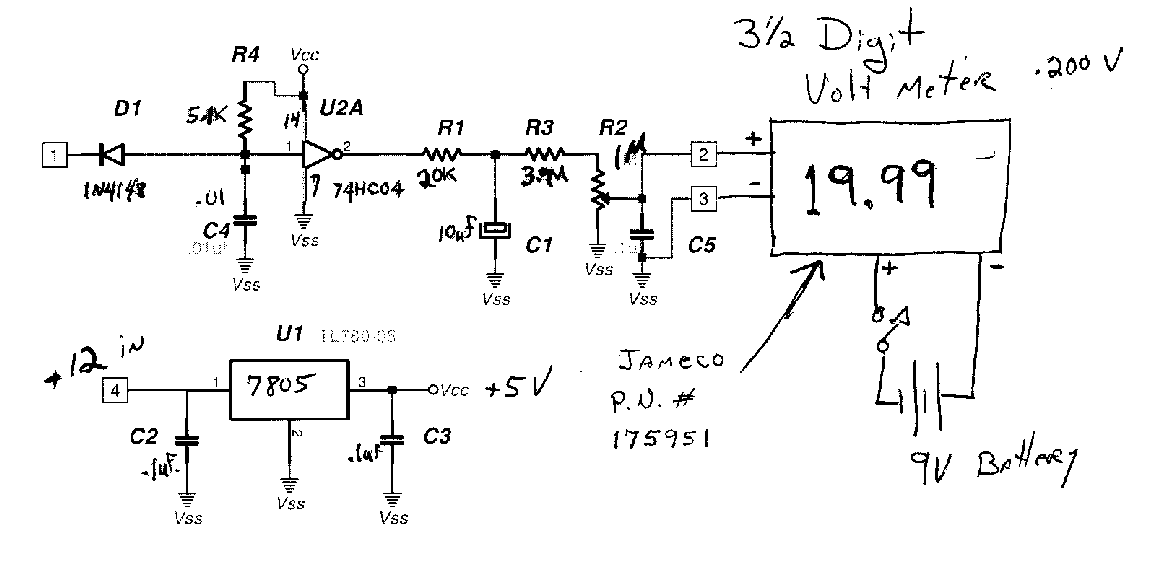
Here's the schematic for the simple digital flow meter.  Full scale is 19.99
GPH which is about optimum for a 13B.    The input is connected to the rotor
1 primary injector driver line on the EC2.    Do not try using a separate 9
volt linear regulator for the display supply because it requires a fully
isolated supply.  An isolated DC-DC converter could be used to eliminate the
battery.  Battery life will be about the same as it's shelf life so it
probably isn't worth the trouble.

Accuracy is only as good as the calibration job .  R2 (1 meg pot) is used to
calibrate the meter.  I would suggest using a ten turn trim pot for this
part.   Follow the manufacturers data (included with meter) to enable the
decimal point display at the position shown.

Tracy Crook
tcrook@rotaryaviation.com
www.rotaryaviation.com
The AirCraft Rotary Engine NewsLetter.              Powered by Linux.
ACRE NL web site.
http://home.earthlink.net/~rotaryeng/            http://www.linux.org