"We also think the original cooling system design was marginal for
desert weather."
Jerry Hey wrote:
I assume you are referring to Perry's original cooling  design but I
think the same is true for the RX-7.

The cooling system in my RX-7 is marginal although it works even in
plus 100 degree situations.  I don't like watching the temps slowly
rising, even if they never reach the red line. This is driving around
at 3000 rpm.   What ever the capacity of the stock rad is, I would
increase it by large amount to handle 6000 rpm heat.  I don't know
the capacity of the  stock RX-7 radiator.  I will have a minimum of
800 cu in in my Tailwind  radiator.  I think it is very risky to
depend on cleaver engineering  to replace rad. cu. in. although all
the cu.in in the world will not suffice in a bad design.  Just my non
educated opinion... Jerry (backyard engineer).
Yes. I was referring to Perry design.

I would like to clarify something at this time for late subscribers.
It is not the RPM per se. It is the amount of HP the engine is generating.

You can cruise down the road with the engine running at 6000 RPM
in  a lower gear with the throttle only slightly open.
HP on the other hand is both a function of RPM and throttle opening.
The average power of a car cruising 60 to 70 MPH is only
30 to 40 HP hence the cooling demands are not very high.
Cooling HP in terms of heat rejection is always about equal to
the HP out of the e-shaft. 746 watts equals one HP.

Now having said that we have to take into consideration the
air pressure we have available to force air through the rad.
At 50 MPH it is 1/4 of what it is at 100 MPH. That is the main reason
the rad in the airplane is not four times larger than it is in the car.
This applies both to the water rad and to the oil cooler.

On the other hand Perry's engine running at 5000 RPM wide open throttle
at takeoff and climb is generating about 120 to 130 HP.
Perry's two rads are only about 13" by 14" with a total thickness
of 2". That is about 400 cubic inches and they worked
pretty good up in cool Oregon. His ducting for the most part is
not bad  with an air outlet very near the pusher high speed fan
for good suction and a NACA duct under the fuselage. As I
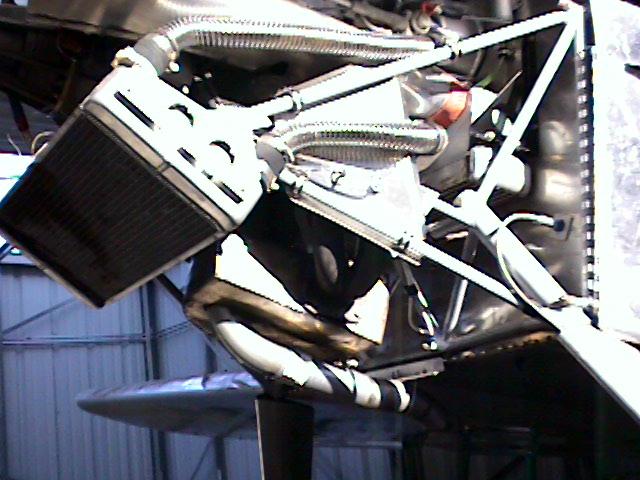
recall Chuck Dunlap's rad is only about 550 cubic inches but
it is almost ideally located just behind the pusher prop under
the PSRU and a streamlined air outlet at the bottom back
of the cowl. His airplane cools fine in the very hostile
environment of southern Arizona. See the attached picture.

I agree. You can have the largest rad in the world and
if the air ducting is not correct both inlet and outlet it
still won't cool. Power Sport proved that last year :-)

Paul Lamar

The AirCraft Rotary Engine NewsLetter.              Powered by Linux.
ACRE NL web site.
http://home.earthlink.net/~rotaryeng/            http://www.linux.org