> > > > >"We also think the original cooling system design was marginal for
> > > >desert weather."
 > >Jerry Hey wrote:
 > >   I will have a minimum of
 > > > 800 cu in in my Tailwind  radiator.  I think it is very risky to
 > > > depend on cleaver engineering  to replace rad. cu. in. although all
 > > > the cu.in in the world will not suffice in a bad design.  Just my non
 > > > educated opinion... Jerry (backyard engineer).
 >. As I
 > >recall Chuck Dunlap's rad is only about 550 cubic inches but
 > >it is almost ideally located just behind the pusher prop under
 > >the PSRU and a streamlined air outlet at the bottom back
 > >of the cowl. His airplane cools fine in the very hostile
 > >environment of southern Arizona. See the attached picture.
 > >
 Mike Wills wrote:
 >
 >   More clarification. I wouldnt get too hung up on core volume. As Paul
 > pointed out in a previous email for a conventional rad (not Pauls
 > cross-counterflow design) the majority of the work is done by the first
 row
 > of tubes in the core. An 800 cu. in. radiator 20 x 20 x 2 inches thick is
 > probably far more rad than you need for a 180HP rotary (assuming proper
 > ducting). On the other hand an 800 cu in rad that is 10 x 14 x 6 inches
 > thick may not cool at all because you cant get any air to go through that
 > core. I have seen pictures of one such installation that was a total
 > failure in a P51 style duct.
 >   Chuck Dunlap was here in San Diego a couple of days ago (thanks for the
 > visit and the ride Chuck!). I'm not sure how big his radiator is but no
 way
 > is it 550 cu in. I'd estimate the core at 14 x 12 x 2 for 336 cu in.
 > Ambient temp at Ramona was 85 degrees and I never saw coolant temp go
 above
 > 200 during our flight.
 >
 > Mike Wills
 Very good point Mike. Frontal area of the rad is where it is at.
 If I had the room the core would be only one inch thick.

 Well yes I could be wrong about that 550 ci number :-)
 I will have to search back through the messages for the exact number.
 Here is another shot. This one shows the rounded bottom of
 the firewall to smoothly exit the cooling air.

 Paul Lamar
Chuck wrote:
> My core is 10.5 x 20.5 x 2.5 inches, or 538 cubic inches volume. It cools
 fine below 90 degrees ambient, but keep in mind I'm probably only making
 about 140 HP max. The radiator I have would be too small for a heavier ship
 in hot weather. Above 90 degrees, I have to reduce throttle to give about
 500 ft/min climb to keep water temp under control.
>
Chuck Dunlap
Done any work on the inlet scoop and duct  since I saw it at Copper
State Chuck? If not I think it could be improved in that area.
I think Chuck just reaffirmed my point.   If the core size is
inadequate (due to a lack of space) then the installation will fail.
Where I live, near Paso Robles, CA, the summer time temps are always
far above 100 degrees and have been known to hit 115.  I haven't
solved all the problems of a good fuselage installation yet, but
putting the rad in the fuselage does eliminate the core size problem.
Checking the temperature to see if you can take off sucks.   Jerry
Paul Lamar
Not really Jerry. Chuck's inlet scoop was less than optimum last time
I saw it. If anything it proves that inlet duct shapes are extremely
important.

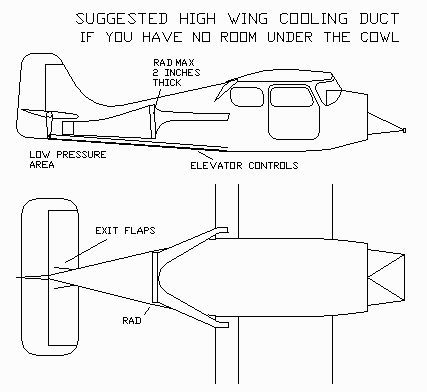
The aft fuselage is hard to get air in and out.
It has to be done right. Since we have not discussed this on here
for awhile and we have many new subscribers I will go over things
again. My suggestion is let the air come out under the horizontal
stabilizer on both sides with cowl flaps as that is a low
pressure area.

The best place to take air in is up under the wings on a high
wing air plane. You will need two scoops. Don't forget to
bypass the boundary layer. These are called armpit scoops when
discussing canards. A long NACA duct starting under the front
seat on the bottom of the fuselage might also work.
Two of those Chrysler minivan rads plumbed back to back
ought to work just great at 32 by 19 by 3/4 inches each
for a total of 900 cubic inches  :-)

I think you would get better pressure recovery and add less drag
if you could squeeze the rad under the cowl. As I recall you
are building a Tailwind so that might be hard to do.

Paul Lamar

The AirCraft Rotary Engine NewsLetter.              Powered by Linux.
ACRE NL web site.
http://home.earthlink.net/~rotaryeng/            http://www.linux.org