Jerry Hey wrote:
Hi Paul,   I'm looking for expert commentary from the members of this
list about the cooling scheme in the attached drawing.   There is
nothing about it that cannot be changed.  In particular I am
interested in hearing more about cooling drag as related to inlet
size.  Are the suggested  inlets too big or too little?     Jerry
Just a few minor improvements in red Jerry. You might want to go up
to 10 by 4 for the openings. The boundry layer bleed space should
be at least two inches below the fuslage skin. When the flaps are closed
the air will bypass the opening.

Paul Lamar
Mike Wills wrote:
  No expert advice here. But the trend that I see with these airplanes as
they start test flying is that most tend to start with undersized inlets
that get hacked to bits to get the cooling under control during the test
phase. IMHO its easier/better/safer to start with an inlet area thats too
large. You can more easily reduce the inlet during testing as need be while
avoiding overheating early in your test program. My inlets will be approx
55 sq. in. for the rad and approx 25 sq. in. for the oil cooler initially.

Mike Wills
I agree Mike.

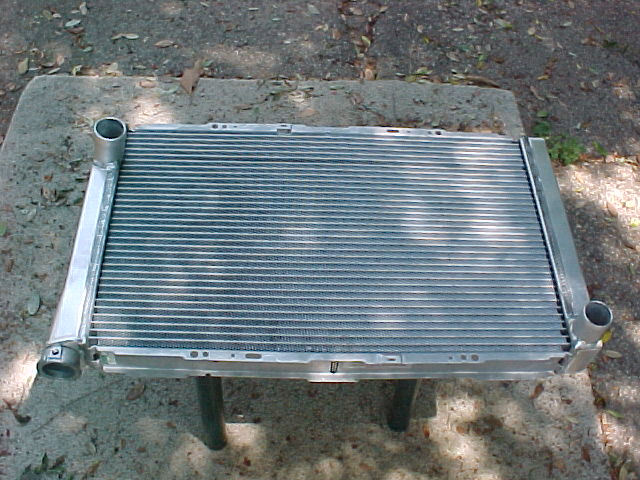
BTW I gave up on my custom rad. I bought a 16 by 27 by 2.25 thick Howe rad
from Summit Racing for $199.95. The core itself is actually 15 by 24 inches.
It looks like a mass produced 2 tube row core designed for plastic end tanks
and Howe just welded on aluminum end tanks. It does indeed look like the
tubes are aluminum furnace brazed into the header plates.

I tried tig welding on a stock 2nd gen Mazda core and it can be done, no problem.
No melting of the brazed tubes takes place due to the convoluted shape
of the stock header plates dissipating the heat before it can reach the tubes.

The labor involved is high however as you must clean the header plates
thoroughly. Preferably with a caustic etch. Using stock cores would make
my custom rad too thick for the space under the cowl so I gave up.
Perhaps I could find thinner cores that would work but they would
no be cheap.

This Howe rad is a quick, simple and cheap solution. Took two days
for Summit to get it to me. I will have to weld custom inlets
and outlets on it but what the hey.

Given the 25% rule for relatively thin rads the opening would be about
90 square inches.

Paul Lamar

The AirCraft Rotary Engine NewsLetter.              Powered by Linux.
ACRE NL web site.
http://home.earthlink.net/~rotaryeng/            http://www.linux.org