> Jerry Hey wrote:
 >
 > Hi Paul,   I'm looking for expert commentary from the members of this
 > list about the cooling scheme in the attached drawing.   There is
 > nothing about it that cannot be changed.  In particular I am
 > interested in hearing more about cooling drag as related to inlet
 > size.  Are the suggested  inlets too big or too little?  Do I need a
 > bell shaped lip on the inlets?  How about the shape of the rad
 > plenum.  As you can see, I have heeded some of the advice you offered
 > months ago particularly with the exhaust flaps under the stab, which
 > I have grown to like.  BTW, the oil cooler will be located in the
 > engine cowl under the drive.       Jerry
 Just a few minor improvements in red Jerry. You might want to go up
 to 10 by 4 for the openings. The boundry layer bleed space should
 be at least two inches below the fuslage skin. When the flaps are closed
 the air will bypass the opening.

 Paul Lamar
BTW don't seal the aft fuselage completly or you could blow the fabric
off  if you don't duct the outlet of the rads to the flapped
openings. In other words if you just dump the rad air into the aft fuselage.
At 100% dynamic pressure recovery the force would be about  100 pounds per
square foot at 200 MPH. Usually inlet ducts are no better than
about 80% or only 80 pounds per square foot :-)

Paul Lamar
Paul,  Thanks for your comments.  I have never considered just
dumping the air into the aft fuselage without providing an exit.  To
dump rad air, I go back and forth between movable flaps  and/or
louvers which would be much easier to install.  The issues that I am
concerned with are sucking exhaust fumes back inside the airframe and
accessibility for maintenance.  To deal with the exhaust, one could
put the intake scoop(s) far enough forward so that the exhaust pipes
would dump out aft of it (them).  Prop wash should keep fumes from
backing up and entering the airplane   If the intake scoop is 10" x
4"  would  one would be sufficient?  To phrase it another way, what
would be the ideal size of the intake scoop?  If you have two scoops,
would they still have the same total frontal area or do boundary
areas and so forth make it more complicated?   Jerry
Actually for that size radiator to really work to its full
capacity you  need roughly 25% of its frontal area or about
20" by 5" or 6".

Dumping the air back there is OK. Just don't seal it up completely
or it will pressurize the aft fuselage with dire consequences.

Have you considered a side exhaust? Ideal for a rotary
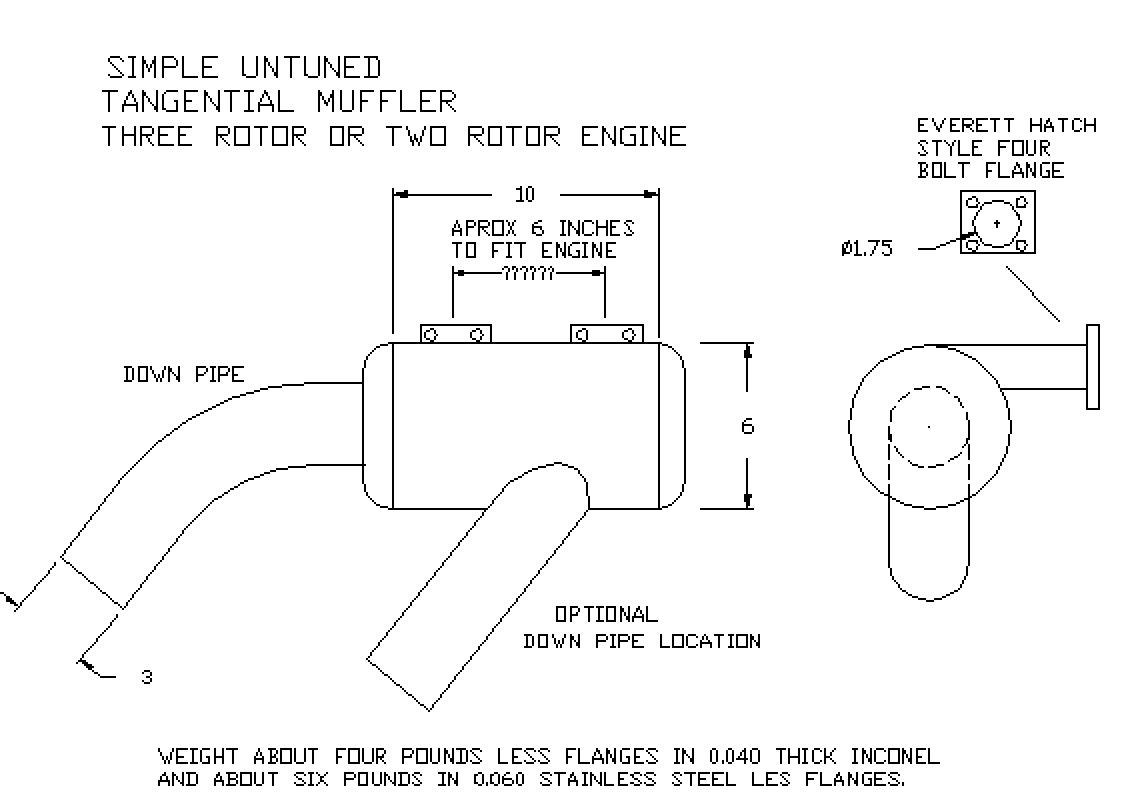
as it gets the heat out lickety split. The tangential muffler
could be in the cowl. Much easier to clean the side of the air
plane rather than the bottom. Neat things can be done
like six small 1-1/4 inch diameter exhaust pipes inline.
That would confuse the heck out of casual onlookers :-)

Paul Lamar

The AirCraft Rotary Engine NewsLetter.              Powered by Linux.
ACRE NL web site.
http://home.earthlink.net/~rotaryeng/            http://www.linux.org