Ken Powell wrote:
Tracy,
Please re-educate me.  I understand that the concept of dynamic supercharging consists of 2 parts -intake pressure wave and exhaust to intake crossover causing a pressure rise in the intake.
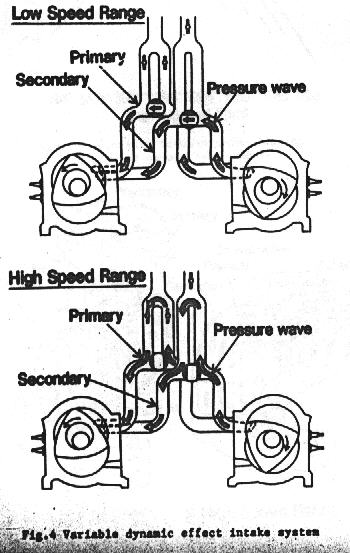
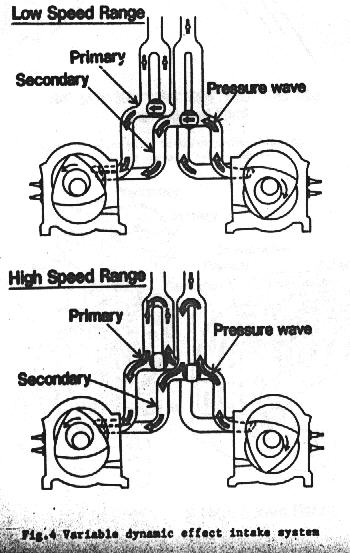
A. Intake pressure wave - one rotor chamber's intake pulse is used to sort-of supercharge the intake to the other rotor. This happens as the intake port closes the air pressure in the intake tract rises. This creates a pressure wave which reverses direction and travels back up the intake track to the opposite rotor at the speed of sound.
B. Exhaust / Intake pressure rise - As the exhaust port closes and the intake port opens the high pressure exhaust will enter the intake tract causing a pressure rise. This also causes a pressure wave which reverses direction and travels back up the intake track to the opposite rotor at the speed of sound.
Based on this theory, on a peripheral port engine there would not be any difference between a dynamic chamber and a plenum chamber - is this correct?  I am planning to build a chamber with a volume of ~ 2 liters.

Thanks,

Ken Powell
kenpowell@aristotle.net
I think you hit the nail right on the head there Ken. Well explained.
Therefor the dynamic chamber concept relies on that exhaust back pressure.

This diagram is from SAE paper 900036 New Technology Employed for the
Latest 13B-Rotary Engine. The HP curve is from an earlier paper that
mentioned the concept SAE 841017.

Paul Lamar

The AirCraft Rotary Engine NewsLetter.              Powered by Linux.
ACRE NL web site.
http://home.earthlink.net/~rotaryeng/            http://www.linux.org