Ian & Irene Beadle wrote:
Mike, a NACA scoop in the side of the cowl will function as an air
exit not
an air inlet, as this is a low pressure area on a RV.
Ian RV6A
Mike Wills wrote:
Ian,

  There's thousands of RVs flying around with NACA vents in the fuse side
just aft of the cowl for cockpit ventilation. The RVs that I've flown in
with NACA vents in the side flowed plenty of air to cool cockpit occupants
(or ignition coils). In fact I think Chuck's RV uses this arrangement for
cockpit ventilation (I was surprised that his muffler is so effective that
there is more cockpit noise due to air coming in the vents than due to
engine noise; very quiet with the vents closed at cruise speed). What am I
missing? Low pressure on the side of the cowl but high pressure 12 inches
further aft?

  I would think even if the side of the cowl was a low pressure spot
(relative to say the front of the cowl) it would be a high pressure spot
relative to the inside of the cowl (which should be low pressure also if
its not pressurized by ram air).

  Sure wouldnt be the first time I made a wrong assumption (hope nobody is
keeping score). :-)

Mike Wills
I think you are missing the pressure inside the cowl Mike. Particularly
if it has cowl flaps that are closed.

Paul Lamar
Chuck wrote:
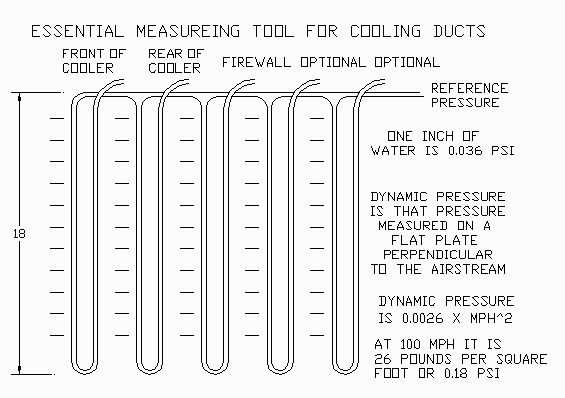
 I think you are right Paul. I measured the pressure inside the cowl with my
new water manometer, which is always referenced to cockpit pressure for all
measurements I make. Open or closed cockpit vents did not make any
difference so I think cockpit pressure is fairly stable. I make all
measurements at 100 MPH indicated. I showed 2.2" rise in water column from
pressure inside the cowl. I then taped up the rest of the nostril intake not
used by the new engine air intake tube, and measured 1-1/2". That 1-1/2"
must be coming from radiator and oil cooler exit air. It would be good to
have zero pressure inside the cowl so that made me think the cowl outlet was
too small so I cut the bottom of the cowling back 2".
That made no
difference so I riveted on a piece of sheet alum. tilted 45 degrees into the
slipstream to make a low pressure area. That may have made a slight
difference, its hard to measure the water to greater than 1/4" accuracy. I
mentioned before that when I tape up the nostril inlet, my ignition coils
get hot, so I got the bright idea of putting a NACA vent on the side of the
cowl right in front of the coils. It did not help. It did not dawn on me
until now that the pressure inside the cowl is the reason this experiment
did not work.
  I am not really trying to be cagey withholding this info :-) It's just that
all of this experimenting has been done in the last couple of cool months
before the summer heat limits comfortable flying time and I simply did not
have time to compose messages! Also it would be nice if I had some positive
results to report, but I suppose even the failures are valuable info.
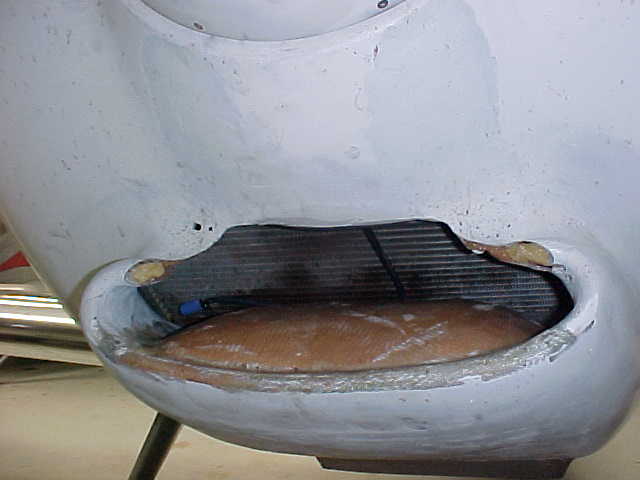
   Back to the manometer measurements, I got between 2.75" and 4" pressure in
various locations in front of the radiator. That is why I put that ugly
"tongue" on the bottom of the inlet, to try to even out the pressure. I have
not measured all of the locations yet, but so far all have been 3". All
these measurements are the distance the water rises in the tubes compared to
static. Of course the water in the other tube lowers that same amount. One
problem with keeping this calibrated is the water evaporates over the course
of a few days and I have to keep moving my scale! Maybe I could change to
salad oil or something that does not evaporate but then all my measurements
would be different due the different mass of oil Vs water.
 Well, Paul, there are some numbers maybe you can make sense of them and
tell us what they mean!

Chuck Dunlap
The height of the water is the difference. If it goes up 2
and down 2 that is 4 inches of water.

OK lets put some numbers on this stuff. One cubic foot of water weighs
65 pounds so if it was sitting on a plate each square inch would see
65/144 or .45 psi so 12 inches of water is .45 psi. If you were
seeing 4" you would be seeing 4/12 times .45 psi or .15 psi.

Putting it in other term one inch of water is .0375 psi.

If you had a flat plate going 100 MPH perpendicular to the air stream
at sea level you would have 26 pounds per square foot or about
.18 psi.

That is called dynamic pressure.

At 150 MPH it is double that or .36 psi or 9.6 inches of water.
at 200 four times that or around 100 pounds per square foot.

The formula for dynamic pressure is .0026 times MPH squared
in pounds per square foot.

Chuck you are the first person to make these measurements
and I want to thank you and congratulate you as we are FINALLY  making
real and I mean REAL!!!!! progress on getting a handle on these
rotary engine cooling problems. Your my main man Chuck!
If you were my student I would give you an A+.

Looks like you need some great big cowl flaps and seal up a few
leaks on the front of the cowl. Don't forget around the prop
spinner and around both radiators.

Also put a bit of porous foam around the end of the manometer tube to be certain
the tube is not facing forward and merely reading dynamic pressure
like a pitot tube would. It is static pressure you are looking for.
Even in front of the water rad.

Thanks again.

Paul Lamar

The AirCraft Rotary Engine NewsLetter.              Powered by Linux.
ACRE NL web site.
http://home.earthlink.net/~rotaryeng/            http://www.linux.org