<<Big snip>>

If you just want NA power at sea level the easiest and cheapest way
to get at least 180 HP and probably 200 HP or more is go to a peripheral
port set up. Lighter weight than the turbo option and no intercooler
would be required.

Paul Lamar
Jerry Hey wrote:
Paul, There are so many different HP claims for  modifications.  I
have been under the impression that I could achieve 180 hp with
street porting.  One "expert" told me that 190 hp was possible.  I
would be delighted with 170 hp.   That is my goal.  I want a little
more than the 0-320 delivers--just for showing off.  This is too much
work to just come out even.   Is 170 hp  a street port number or do I
have go to peripheral ports?  Also, I am confined by drive ratios
(2:1) to around 6000 rpm max.  How is PP in the 5000 to 6000 rpm
range?
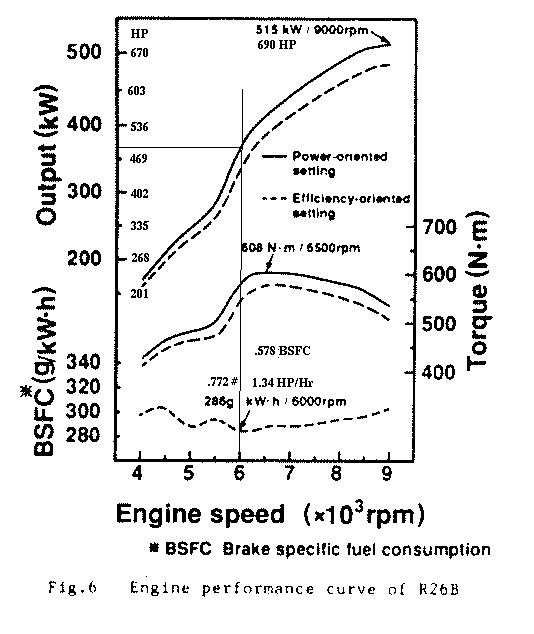
I thought you had a 2.85:1 PSRU Jerry. 180 HP is no problem at 7000 RPM
I was referring to the HP you can get at 6000 RPM with a 2.17:1 PSRU.
Street ports are good but not as good as a PP. With a good PP you could
probably get half of what is shown on this chart or 240 HP at 6000 RPM
and 300 HP at 7000 RPM. PP are still good at 5000 RPM but with a
fixed pitch prop you will be running at part throttle at sea level.
Up at 8000 feet the throttle should roughly be wide open with the
engine running at 5000 RPM. The HP will be down however from
what is shown on this sea level chart. PL
On another topic, I finally got to tape little bits of yarn to a
Tailwind belly.  Unfortunately, we could not locate another plane for
inflight photos, but on the ground with the tailwheel on the ground
and also raised to level flight attitude, prop blast caused the yarn
to flip back and forth  like a wind sock in a stiff breeze but in
every case from idle to 1500 rpm, the yarn more or less maintained
contact with the skin.
You are in the boundary layer.
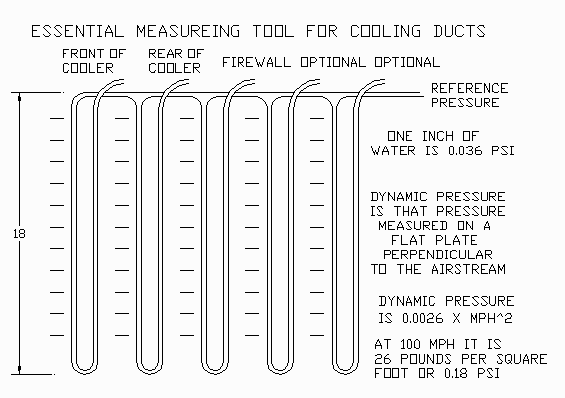
Make a velocity rake which is a series of six simple pitot tubes
spaced 3/4 of an inch apart and measure the pressures below the fuselage
with this plastic tube water manometer and tell me what they are.
Use the cockpit for a static reference pressure. The lowest pitot
tube in the velocity  rake should be about four inches below the skin.
The numbers will be the difference in the height of the two water
columns in inches. Fill the U tubes about half way up. Drip irrigation
tees and angle connectors are available in the garden shop to make
a water manometer. PL
I am all the more optimistic about under
fuselage inlets.  There was a lot of air moving along that skin. It
seemed to be much stronger in the center of the fuselage than out to
either side.  I think a NACA or parallel sided duct with a movable
lip that could be lowered into the airstream for long on the ground
operations would be very likely to work.   Also, I have been
visualizing a bit of sheet metal that would form a tunnel under the
inlet. It would be open at both ends but the outlet would be narrowed
so that air passing through the tunnel  would be compressed and much
more likely to enter the inlet.   Based on what I saw yesterday,
this open tunnel would be in serious air if it was just one inch
below the belly skin.  One inch inlet and maybe 1/4" at the outlet.
I am imagining its length to be about 1/2 the naca ramp.  In my case
the tunnel would begin approximately where the ramp is about 1.5
inches deep.      Jerry
The AirCraft Rotary Engine NewsLetter.              Powered by Linux.
ACRE NL web site.
http://home.earthlink.net/~rotaryeng/            http://www.linux.org