In my spare time I am reading this book co written with
Edgar Schmued who was the project manager on the P51.
Probably had more say on what the P51 was like than
any other single man. The engineering team however
was 40 strong more or less. Even Art Chester had some
inputs on the sheet metal box motor mount design.

The book was called Mustang Designer by Ray Wagner 1990.

Interesting stuff on the radiator duct. Edgar knew about
external diffusion and felt that it was bad for drag on
anything down stream from it so he placed the radiator in
the aft fuselage and the inlet opening as far aft as possible.
He called it "spillage".

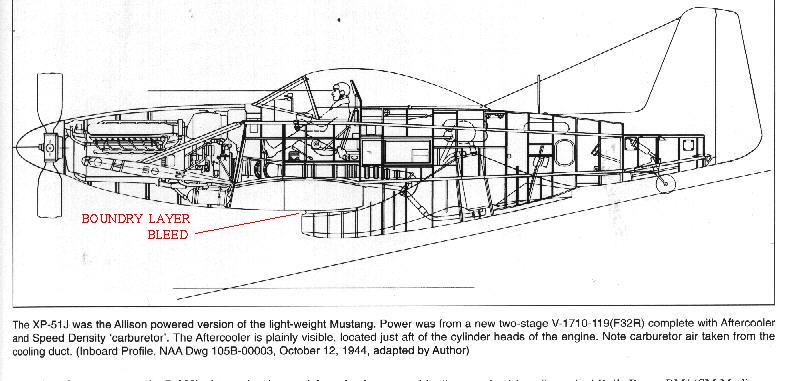
Up until that time nobody used a boundary layer air bleed.
The P51 prototype did not have one. There are two stories about
who was responsible for the boundary layer
air bleed. One gave credit to an Englishman
a Dr. B.S. Shenstone and the other to Irving Ashkenas as
being responsible. If the bleed was too much or the duct too low
the external drag was too high. If no boundary layer bleed was
used the duct did not recover as much dynamic pressure.
They also got into a situation where the duct rumbled when the
boundary layer alternately entered and did not enter the duct.
They fixed that by lowering the duct and later by slanting
the lower part of the lip aft. Much of the work was done with
the aid of a wind tunnel.

They discovered the low drag aspects of the design later and
it was attributed to the heating of the exit air adding energy
to form a minor jet effect. An Englishmen by the name of F.W.
Merdith wrote a paper on the subject back in 1935. It was
called the Merdith effect.

Despite all that a book by Kuchemann & Weber published in 1953
called the Aerodynamics of Propulsion proved the internal shape
of the P51 duct walls was all wrong. No telling how fast the P51
would have been if the ducts were designed to the bell shaped
principles of Kuchemann & Weber :-)

Paul Lamar
Alfonso Lebron-Berges wrote:
Paul,

I might have missed one message but can't figure out that of boundary
layer bleed. Could anyone elaborate a bit about how the ducting is
made at this particular area?

Thanks,

Alfonso Lebron-Berges
It is the area just above the duct opening. It bypasses the
slow moving turbulent boundary layer.

Paul Lamar


The AirCraft Rotary Engine NewsLetter.              Powered by Linux.
ACRE NL web site.
http://home.earthlink.net/~rotaryeng/            http://www.linux.org