Wrathall Mark wrote:
Greg,

Congratulations for getting a rotary powered aircraft to Oshkosh. That is a
hell of an acheivement.

Looking at the photo's Paul sent, I picked up a couple of points which might
cause a concern (or might just be hidden in the photo. Most of the braided
hoses look well supported with p-clamps, but the ignition leads and wiring
harness seem to be tye- wrapped, which is not AC43-13b conform.

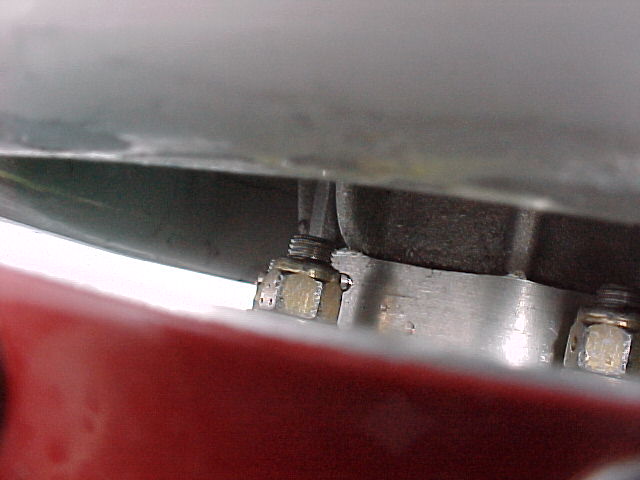
Are the ends of the big AN braided hose above the fly wheel supported? This
tube could be working your radiator fitting welds otherwise.

Mark Wrathall
www.rotary.microcosman.com

Mark Wrathall
It may be several days before Greg gets this message Mark as OSH is still
going on and he must fly back to Georgia.

The following airplanes showed up this year by Saturday noon.
The weather was bad in the Midwest so others might have tried.

Name     Airplane Intake State
Finn Lassen RV3 - NA --- Florida
Tracy Crook RV4 - NA --- Florida
Jim Moser   RV6 - NA --- Ontario Canada
Power Sport RV6 - NA --- Wisconsin
Dave Atkins RV6 - NA --- Washington state (probably the longest distance)
Greg Richter Cozy Turbo  Georgia

NA stands for normally aspirated.
This is 50% more than we had at Sun and Fun and 100% more than
we had at OSH last year.

Nobody entered the NC to OSH race so the Everett Hatch Memorial Prize
money fund is still intact at $1600.

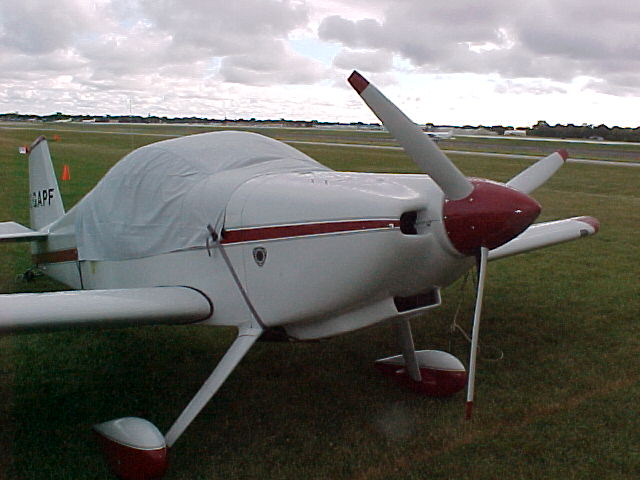
This is a picture of Jim's airplane. Jim uses copper or brass
rads that are smaller and heavier for equivalent cooling than alum rads but
are more fragile. According to Jim a big bug impact at 200 MPH
can cause a leak.

So far nobody has taken my advice and sealed
up the area around the prop. This causes higher pressure behind
the rads in the cowl and reduces the cooling air flow through the rad.
I am very disappointed.

Both Power Sport and Dave Atkins are still passing the cooling air over
the hot engine first which warms it up before it gets a chance to
pass through the rad and cool the engine. Since the heat transfer
is directly proportional to the temperature difference between
ambient air (as high as 110 F) and the temperature of the radiator
(about 220 F) as little as ten degrees F warmer cowl or ambient air
can make about a ten percent reduction in cooling. This results
in a larger and heavier rad and more aerodynamic drag all other
things being equal.

Running cooling test with out recording the air temperature in the
cowl the pressure in the cowl and or the ambient air temperature
makes no sense.

Paul Lamar

The AirCraft Rotary Engine NewsLetter.              Powered by Linux.
ACRE NL web site.
http://home.earthlink.net/~rotaryeng/            http://www.linux.org