Two more questions guys.

A: Are your planet carriers bolted rigidly into the unit?
Ford designed those planet carriers to float and self align in
slots in
the housing. Tracy does not subscribe to this design philosophy
as he believes he can line things up perfectly. Tracy noticed
evidence of the planet carrier moving around in the slots
and he attempted to epoxy it in place on his original Ross gear
box.
Not bolted, mine is press fitted. I just pulled it out. On closer
examination all four planet gears are similarly worn (not nearly as
much as
the sun gear). Except for one, which is severely worn on the
backside!
Weird!
B: Are your ring gears welded to the ring gear bulkhead?
Ford designed those ring gears to float on the bulkhead splines.
In some Ross boxes the ring gear was welded to the bulkhead.
Don't know how the ring gear is in it's native state. Attached
picture into
the ring gear shows some discoloring that could indicate a weld.

Also shows the poor lubrication scheme. The thin hole is in and the
bigger
out.

Finn
That bulkhead is news to me. Never saw one of those before. Anybody
else
have a bulkhead like that? Can you wiggle the ring gear around on it
Finn?
Paul Lamar
No, the ring gear is fixed to that, and the bulkhead to the prop shaft.
I thought
the bulkhead was part of the ring gear?

Finn
I got one right here just like Tracy uses and the ring gear wiggles
around on the bulkhead.

Paul Lamar
All the Ross drives I've seen have the welded bulkhead.  It is not the stock
Ford part (which I use in the RWS drive).  I like the stock bulkhead for
several reasons including the splined fit that allows the ring gear to self
align and it is not prone to heat distortion and misalignment during
welding.  Welding also introduces the chance of messing up the heat treat on
the gear too.  Using the stock bulkhead also makes replacement easy.  It is
splined to the prop shaft so it comes off.  It also separates the gear
thrust from the prop thrust which are handled by separate thrust bearings.
On a tractor prop installation with the Ross drive the thrust adds together.
The thrust bearing in my Ross drive was bad at 650 hours.

Tracy Crook
tcrook@rotaryaviation.com
www.rotaryaviation.com
I agree on the splined bulkhead Tracy. I only worry about what it is
made of. Since we now have six pinions there may be another weak link
lurking out there to bite us sometime in the future :-)
In Don Dunbars case he needs to make a copy of that bulkhead in
4130 or 4340 as he will be screwing it to the prop shaft.
I would not trust the stock powdered metal bulkhead in that case.

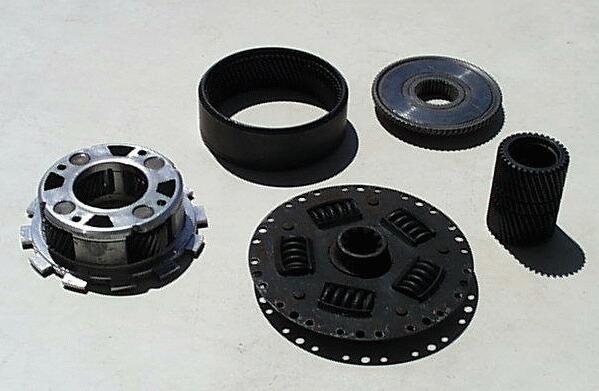
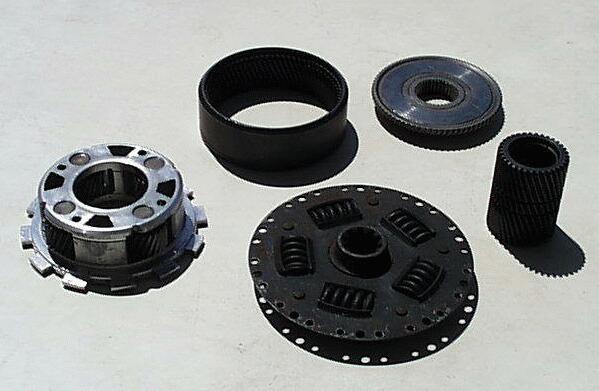
BTW Finn, here is what the complete set of Ford parts look like.
As you can see the bulkhead is a separate part from the ring gear.
This I think is the fundamental problem with the late Ross boxes
with the tied down planet carriers. There is no way for the gears
to self align.

Incidentally planetary gears were used in aircraft engines
as far back as 1917. The Rolls Royce Falcon V12 with 280 HP
had a 56 pound planetary gear box. RPM of the engine was 2500
and prop RPM was 1327 RPM so the torque was enormous.

The Rolls Royce Eagle V12 also had a planetary and that was 360 HP
at 1800 engine RPM with 1080 prop RPM. This was the engine that
got the Vimy WW I bomber across the Atlantic ocean as I recall. In this
case the gear box weighed 64 pounds. Total engine weight was 900
pounds with the planetary gear box.

The final engine in this series was the V12 Condor with 600 HP
at 1750 engine RPM and 1167 or 970 prop RPM your choice.
This engine weighed 1300 pounds with a 100 pound planetary gear box.

Jane's Fighting Aircraft of WW I.

When designed right planetaries are very reliable indeed.

Paul Lamar

The AirCraft Rotary Engine NewsLetter.              Powered by Linux.
ACRE NL web site.
http://home.earthlink.net/~rotaryeng/            http://www.linux.org