Thanks for the great data Jim. Too bad about no pressure data. Hard to
tell
what is going on with out that. Course cooling is the bottom line.
Perry Mick wrote:
I'm still having high oil temps, I think the problem is my
oil cooler exit cowl opening.

Rather than use a water manometer, I'm going to try to use
an old airspeed indicator I have laying around that reads out in
mph.  Hopefully this will work and be easier to use than
tubes full of water.

Here is a conversion table I came up with:
        dynamic (pitot) pressure
        q = ps - p = (r/2) * V^2

V, mph  V, fps  r       q, lb/ft2       q, psi  q, in. H20
0       0       0.0024  0.00    0.00    0.00
10      15      0.0024  0.26    0.00    0.05
20      29      0.0024  1.02    0.01    0.20
30      44      0.0024  2.30    0.02    0.44
40      59      0.0024  4.09    0.03    0.79
50      73      0.0024  6.39    0.04    1.23
60      88      0.0024  9.20    0.06    1.77
70      103     0.0024  12.53   0.09    2.41
80      117     0.0024  16.36   0.11    3.15
90      132     0.0024  20.71   0.14    3.99
100     147     0.0024  25.56   0.18    4.92
110     161     0.0024  30.93   0.21    5.95
120     176     0.0024  36.81   0.26    7.09
130     191     0.0024  43.20   0.30    8.32
140     205     0.0024  50.11   0.35    9.65
150     220     0.0024  57.52   0.40    11.07
160     235     0.0024  65.45   0.45    12.60
--
Perry J. Mick
Duckt N7XR
http://www.ductedfan.com
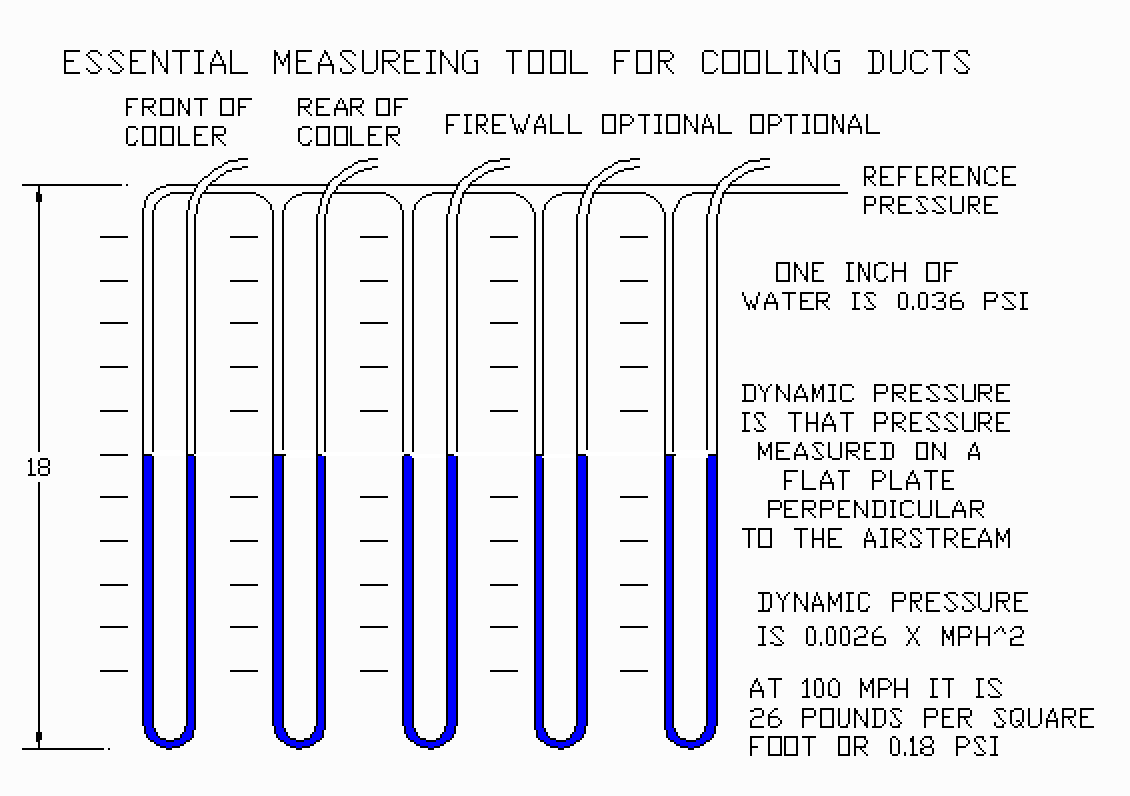
The advantage of a water manometer is you can take more than one measurement
simultaneously. This gives you better results. You can make one of these out
of plywood and clear plastic tubing in half an hour. Hold the tubing
in place with safety wire and small holes drilled in the plywood.

Paul Lamar


The AirCraft Rotary Engine NewsLetter.              Powered by Linux.
ACRE NL web site.
http://home.earthlink.net/~rotaryeng/            http://www.linux.org