Ken Powell wrote:
Monty and I were discussing the Mazda pump and he noted the quality of
the housing and the pump;  this made me wonder why it didn't seem to work
better because you certainly could not look at the pump and see obvious
mistakes (except the small opening for the outflow).  Ray's
numbers  indicate that the pump is not the problem.  Also note that Tracy
and others are getting adequate performance with installations that
theoretically should not work.  I think that Ray is correct and the pump
is not the problem.  Ray's numbers prove this for me - Ray, thanks for
sharing your research.  This is very important and I know that I could
not have duplicated this test.  Design a cooling system with low
resistance and there will not be a problem.  Paul's efforts to open the
flow out of the water pump should also promote more flow and less restriction.
Ken Powell
kenpowell@aristotle.net
Mike Wills wrote:
  Yes, it is finally clear to me that Powersport is pumping a total of
61gpm through their cooling system (51gpm through the engine and 10gpm
through the oil cooler). I dont think I was the only one who was not clear
on this before.

  Yes, it makes sense to me that increasing flow rate should improve
cooling. Powersport's experience shows that. Should help to dispel that old
wives tale that a restriction is required in the system to allow the
coolant enough time in the rad to cool. I still hear people claim that
placing restrictors in place of thermostats accomplishes this.

  It is not clear to me that Powersport has accomplished this increase in
flow with no mods to the stock pump. Is this in fact true? This gain in
flow rate over the previous rate of 31gpm was accomplished solely by going
to the single pass rad? Furthermore Ray mentioned there was no impact on
engine flow rate at all regardless of whether or not the oil cooler was
installed. This increase in system flow rate (from 51gpm to 61gpm) was
accomplished with no mods other than the addition of the oil cooler?

  Finally, it is NOT clear to me that you can make a blanket statement that
this increase in flow rate is required for all installations based on
Powersport's experience. Apparently for their installation it was required.
I wasnt doubting or questioning Ray's numbers on flow rates (though he
apparently took it that way). I want to know why they needed that much flow
for their installation when others do not? I suspected that it had
something to do with the oil cooler. Still waiting for an alternative
explanation. I know of at least 3 flying 13B powered aircraft using 2
series radiators plumbed with 1" hose and all 3 are cooling adequately. I
believe all 3 are using stock pumps. Not to say that I advocate this config
but it would seem to indicate that for some installations this high flow
rate isnt necessary.

Mike Wills
According to Bill Carroll Rotary Engine Manual page 148 the pump is
254 US pints per min max or about about 32 gallons per minute. My 13B
Cosmo manual on page T:2 in the appendix says 42 US gallons per minute at 6500
engine RPM. The pulley ratio is 1:1.8. It is amazing that Power
Sport was able to increase the capacity of the stock pump by 50%.
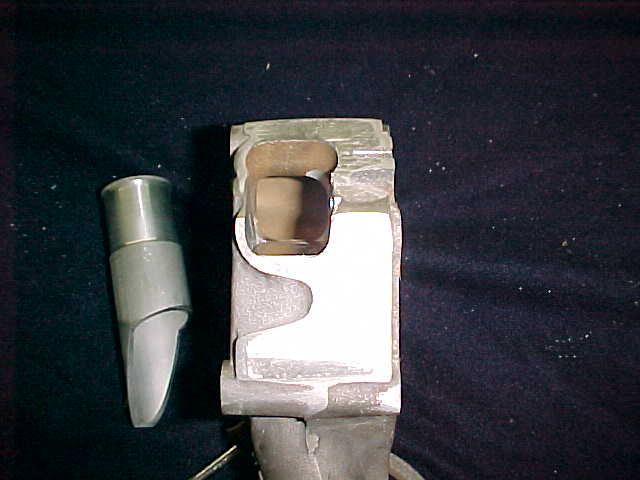
How exactly did you do that Ray? If you calculate the area of all the
tubes in the stock radiator it comes out to be much much larger than
the area of the feed pipes. Radiator restriction I suspect is less
than block restriction.  Did you mill out the restriction
in the pump outlet from the block  as shown in this picture?

Paul Lamar

The AirCraft Rotary Engine NewsLetter.              Powered by Linux.
ACRE NL web site.
http://home.earthlink.net/~rotaryeng/            http://www.linux.org