<SNIP!>
Don Dunbar wrote:
Hi Jerry
Some year ago I came across many diesel engines with in line thermostats
that went in the rubber hose.
They where light weight made of brass and where made in Germany.
One could have a valve to open but that would be going backward.
There is also the problem of the water travelling to fast and if my
memory
serves me it is around 20 ft per second.
Regards Don
Tom Kendall wrote:
This is my first post here guys, so I hope I'm not violating any protocols.
Been lurking the last couple of weeks soaking up a lot of good learning
while lots more is going way over my head.  Some day I hope to build a
rotary powered RV or similar, but for now it's learn what I can and get the
kids through college!

Don mentioned water velocity and and asked what would be too fast.  I'm a
mechanical engineer and specialize in electrical power plant design,
maintenance, and operation (nuclear power plants to be precise).  Everything
is grossly over-designed for both safety and reliability, and you could
never build an aircraft with the margins we use and get it off the
ground.... well, with enough C4 it would probably fly... briefly.

Anyhow, the rule of thumb we use for water systems (and I'm talking about
steel piping, not rubber hoses) is less than 10 feet/second.  Higher than
that starts getting into frictional pressure losses that are excessive for
most applications.  In addition, higher velocities will erode softer metals
like copper and brass, especially as the water gets hotter.  In some cases
we go up to 20 feet per second, but that's really bookin' it, and we have to
make large radius bends and use harder steels (Chrome-Moly or stainless
steel) to make the systems last.  Finally, if you are working with the
suction line to a pump, the rule of thumb is no more than 5 feet per second.
Slower is better.  This minimizes problems with cavitation and vortexing at
the pump suctions.

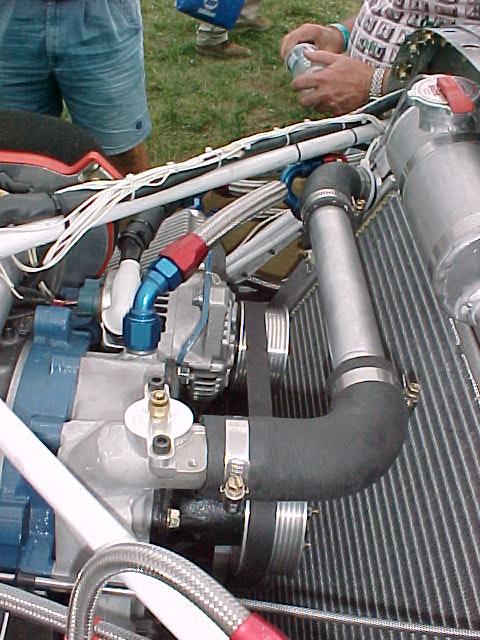
I'm curious what size lines PowerSport is using, since the 51 gpm seems like
it would result in very high velocities in any reasonably sized piping.
Heat Exchangers generally work best at higher velocities (thinner laminar
boundary layers on the liquid side).  But ideally a heat exchanger will be
"impedance matched" for best efficiency.  That is, the heat transfer
coefficients on the the air and water sides will be roughly equal.  You can
boost liquid flows way up to try to get more heat removal, but if the air
side is removing as much as it can, the increase will be only marginal.
Running ~51 gpm would require a very large rad to slow it down to match air
side removal capabilities, or have very high air side velocities and lots of
fins, or it is running inefficiently.

Not bad-mouthing PowerSport mind you (I've seen 'em at OSH the last two
years running, and it is one impressive product), but I am curious how all
the thermodynamics and hydraulics are working out!

Oh yes.  One other thing I keep seeing is mentions of rad cap pressure
ratings.  Keep in mind these beasties are differential pressure devices, not
absolute pressure devices.  That means a 15 psi cap is 15 psi (or ~1
atmosphere) above whatever the barometric pressure is.  I gotta believe that
lower pressure caps (like 5 psi) could be a problem.  At ~10,000 feet you
would only have about 1 atmosphere of real pressure rating on the rad.
Unless you had some significant glycol, pump cavitation and/or boil-over
could be a real problem.

Tom Kendall
Good post Tom. Thanks for the tremendous insight.

I think Power Sports biggest problem is cool air flow to the rad
both in and out. There is no doubt the pipes and rad are more than big
enough.

Paul Lamar

The AirCraft Rotary Engine NewsLetter.              Powered by Linux.
ACRE NL web site.
http://home.earthlink.net/~rotaryeng/            http://www.linux.org