Don Dunbar wrote:

Hi Paul,
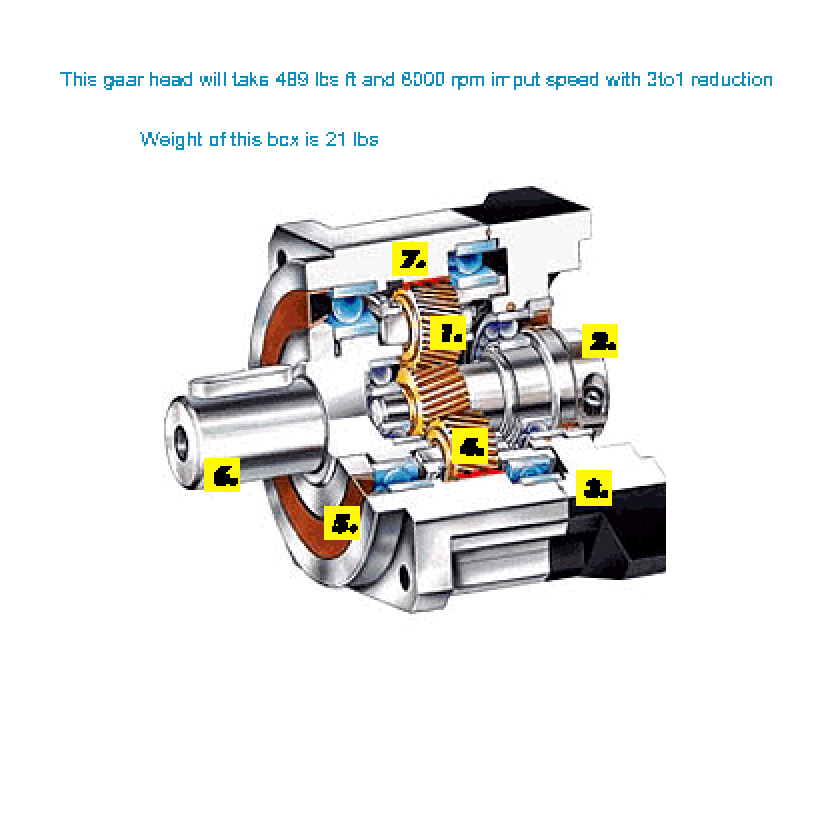
I came across a range reduction boxes that may of interest. The file attached show's the construction of this box with the performance of the PS115.
I have no price as yet but they are made in the Port Washington in the US so I will add the web site and maybe one of the group can follow this up.
The web page with specifications can be found at www.baysidemotion.com
They have all the Radial and Axial loads listed. Does any one have figures for these loads that 250hp propeller produces.
Regards Don
That is a nice unit. Right about our ball park HP and reduction ratio.
Sure illustrates how small and light a planetary reduction unit can be.

The front bearing is fine for radial and axial loads but a prop introduces
bending loads in the output shaft. The front shaft would have to be
redesigned and another prop shaft bearing added. In a boat this
would be coupled to the prop shaft with a lower strut bearing.

The gyro loads a prop introduces into the prop shaft is a function of its
moment of inertia. A metal prop is much worse than a wood prop.
Airplane can see a pitch or yaw rate of one radian per second or more.
That is about 60 degrees per second. Say you stalled your airplane and the
nose dropped down 60 degrees. You can also get these kinds of pitch or yaw
changes in turbulence. Aerobatics of course also introduce gyro loads.

>From the Sky Ranch Engineering manual page 437 Sacramento CA
(916) 421 7672 $25!

The radius of gyration of a five foot metal propellor with 20 pound
constant cord blades is K = 2.5 feet.

Half the diameter.

Moment of inertia I is mK^2 = 3.89 slug-ft^2

where m is the mass of the prop in slugs.

slugs = weight/ 32.2

Angular velocity of the prop at 1500 RPM  w = 157 radians per second

Pitch rate wp is 1 radian per second.

The torque on the prop shaft then is Torque = I X w X wp = 610 foot pounds.

If the bearings are six inches apart each bearing will see
1200 pounds radial load plus of course an axial load of what
ever thrust the prop is generating.

Paul Lamar

The AirCraft Rotary Engine NewsLetter.              Powered by Linux.
ACRE NL web site.
http://home.earthlink.net/~rotaryeng/            http://www.linux.org