Tom Kendall wrote:
I am working on another article for the EAA
so I need some help from you heat transfer guru's.

Anything incorrect in this fragment?
Anything that could be worded better?

"There is no cooling but air cooling. Ultimately all waste heat
must be dissipated to the air surrounding the aircraft. There
are three main ways of transferring heat. Conduction, convection
and radiation. Conduction takes place within the same solid
while convection happens between a solid and a fluid such as air
or water.  Radiation takes place by one object "seeing" another
hotter object. No not nuclear radiation.  You can get a sunburn
at the beach no matter how fast the cooling breeze is blowing.
You do not get a sun burn if you are in the shade. This is a
classic example of heat transfer by radiation. We are mainly
concerned with conduction and convection when cooling an engine."

What do they call the amount of heat transferred per unit time
through a given area such as a cylinder wall? Is that called "flux"?

Paul Lamar
Tom Kendall wrote:
Good write-up Paul.  Only one possible quibble, and that is in the second
sentence:  Heat must be dissipated (or rejected) *to* the air, not "by" the
air.

You are correct with the term "flux".  Typical units are Btu/min-sq.in., and
Watts/sq. cm.  And thanks for the quip about nuclear ; )
Thanks Tom.

That leads to another term which is HP per square inch.
I may not put this in the article but that is one reason
aircraft engines are only around .5 HP per cubic inch.
It has to do with the heat flux through the cyl head to the fins.
That is also why a low displacement, high RPM, geared down piston engine
is not all that great of an idea for a heavy duty engine.
Especially sea level turbo or super charged.

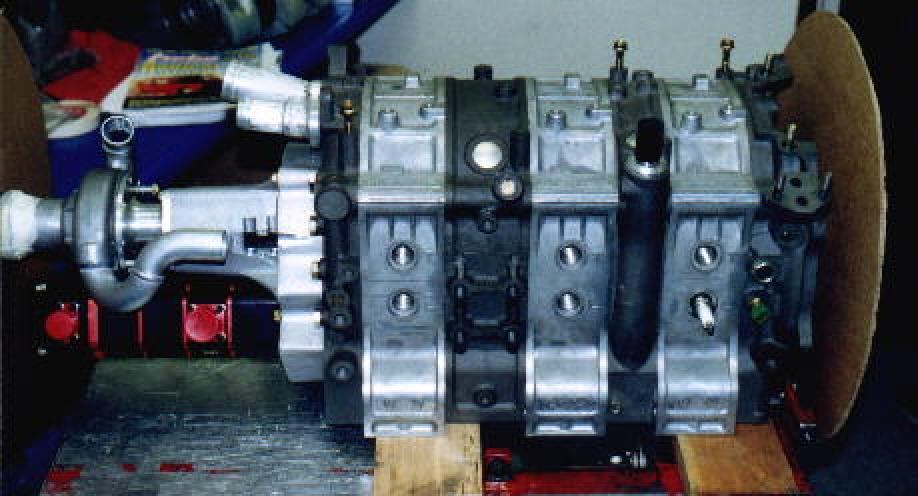
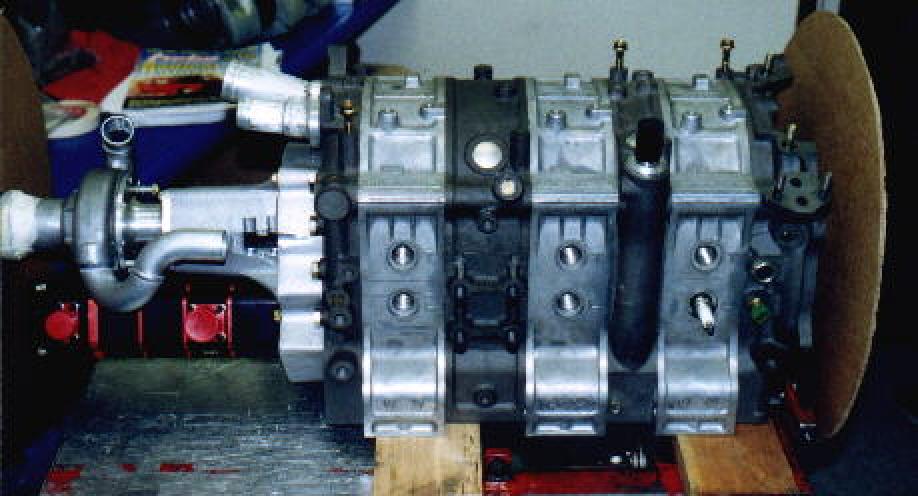
I am still thinking about the implications this has on the wankel engine.
One side of the rotor housing catches hell heat wise as it never gets
much of a chance to cool off. We are still in our infancy on knowledge
on this subject. For example how much continuous HP can we really get
for how long without warping or cracking the rotor housings. We sorely
 need those thermocouples down near the combustion chamber so we can start
gathering data on this subject.

Jim Mederer Racing Beat is working on this by using an extra water
inlet for the block. The lower of these two water outlets from the
custom direct drive water pump goes straight ahead into the block
on Jim's 900 HP turbo three rotor.

Paul Lamar

The AirCraft Rotary Engine NewsLetter.              Powered by Linux.
ACRE NL web site.
http://home.earthlink.net/~rotaryeng/            http://www.linux.org